The City of Houston is working on its recycling problems, but individual Houstonians need to do their part by Recycling Right
by Susie Hairston
Houston’s recycling rate is abysmal —— only about 18% of its waste is recycled, according to city estimates, which is less than a statewide recycling rate of 23%, and a national rate of 32%, as reported in a June 2026 Houston Chronicle article.
The contamination rate of Houston’s recyclables is also an unacceptably high 42%. The costs of this contamination are huge and resulted in the recent appearance of the operations manager and the VP of engineering and post collection from FCC Environmental Services, the company that sorts all of Houston’s recyclables at a state of the art Materials Recovery Facility (MRF), at the May 2026 meeting City of Houston’s Resilience Committee to discuss how Houston misrepresented the recycling contamination rate when it was negotiating the contract it signed with FCC, the 2.5 million dollar loss FCC incurred last year as a result of the excessive contamination in Houstonians’ curbside bins, and solutions to the problem moving forward.
When the City of Houston negotiated a contract with FCC in 2018, it represented in its RFP (Request for Proposals) that the city’s contamination rate was less than 25%. As FCC pointed out at the Resilience Committee Meeting, since 2019, when FCC began processing Houston’s recycling, the contamination rate has averaged 40%, with the current rate being 42%; that additional 17% is resulting in financial losses for FCC for several reasons. Lines have to be shut down for hours to remove tanglers (plastic bags, metal wires, etc), equipment breaks and has to be fixed, labor costs go up as it takes longer to process the material, and FCC has to pay landfill tipping fees for the extra 17% of contamination that was not accounted for in the contract. As a result of the excessive contamination, in order to end up with high quality bales of sorted materials that can be sold for good prices in the recyclables market, FCC has to put more time into processing the materials, thus raising the cost of production and reducing the profit. If FCC does not put more time and energy into eradicating the contamination, the final bales of separate materials, due to the high rate of contamination going in, would have a rate of contamination that would lower the price they could sell the bales for. Either way, FCC loses money as a result of the excessive contamination. Further, since they were expecting a lower contamination rate, they have suffered revenue losses for the 17% of materials that should have been recyclable but are not.
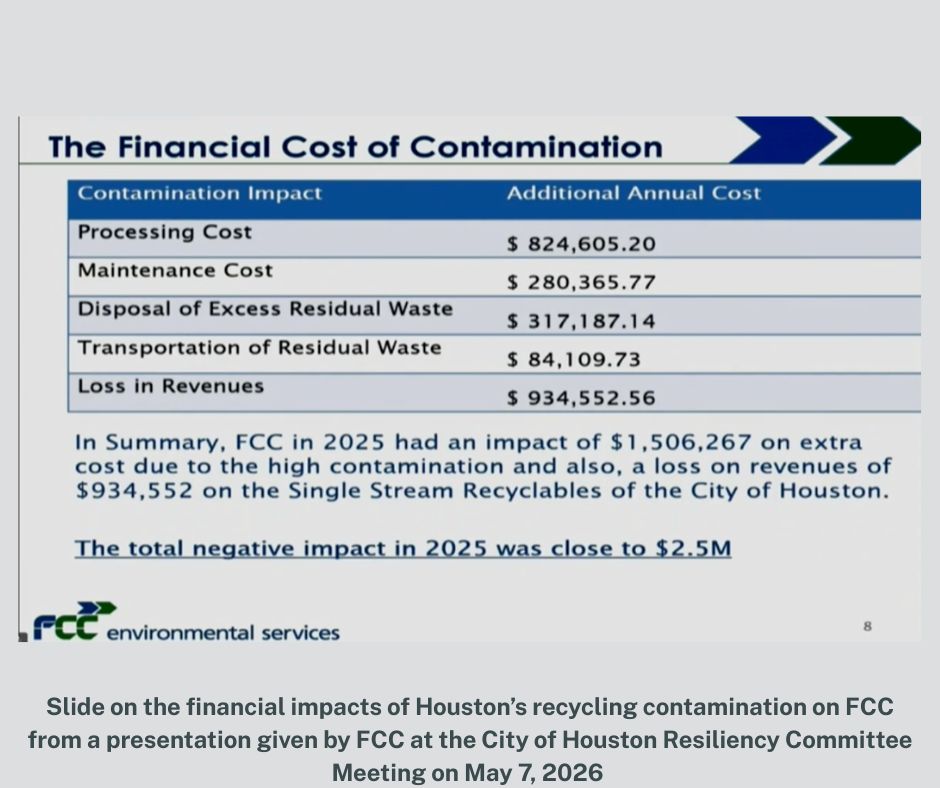
If you wonder why you should care about the financial losses of a waste management company, the losses are not only the company’s. Their contract allows them to reject loads if the contamination rate is above 25%; if they were to act on that option, the city would have to landfill those materials instead. Currently, the city pays $21 per ton for processing the recyclables; if the company rejected 17% of the materials due to contamination, the city would have to pay to landfill that material at the cost of $33.94/ton. Clearly, cleaning up the recycling stream and increasing the rate of clean recycling would save the city, and thus taxpayers, money. Further, recently, the city hired a consultant to look at the contract between FCC and the city and found that the fair thing to do would be for the city to compensate FCC for some of its losses due to the misrepresented contamination rate. Also, the contract between FCC and the City entails a profit sharing formula where the city gets revenue from the sale of high quality sorted recyclables. The more uncontaminated high quality recyclables, the more revenue the city receives.
It is clear that cleaning up Houston’s curbside recycling is a benefit to all. It protects our natural world: making products from recycled materials saves money, water, and energy and requires less use of virgin materials, whose extraction pollutes and destroys ecosystems and human communities. It will also be financially beneficial to FCC, the City and Houstonians.
Solutions:
All parties agree that doing a better job educating Houstonians about recycling is a key to lowering the contamination rate. FCC contributes $100,000 a year to a fund that is supposed to go towards educating Houstonians about recycling. Additionally, a budget amendment to the recently passed City of Houston budget, has set aside $250,000 for that purpose as well. FCC advises using these funds for targeted education that includes clear signage on recycling bins and tagging of contaminated bins to let individual residents know what they should not put in there. Other cities who have tagged individual bins, found this method substantially lowered contamination rates. As Andrea Rodriquez, VP of engineering and post collection at FCC pointed out, when Houston tagged bins in a limited area for a short time, the rate of contamination temporarily went down to 36% from 42%.
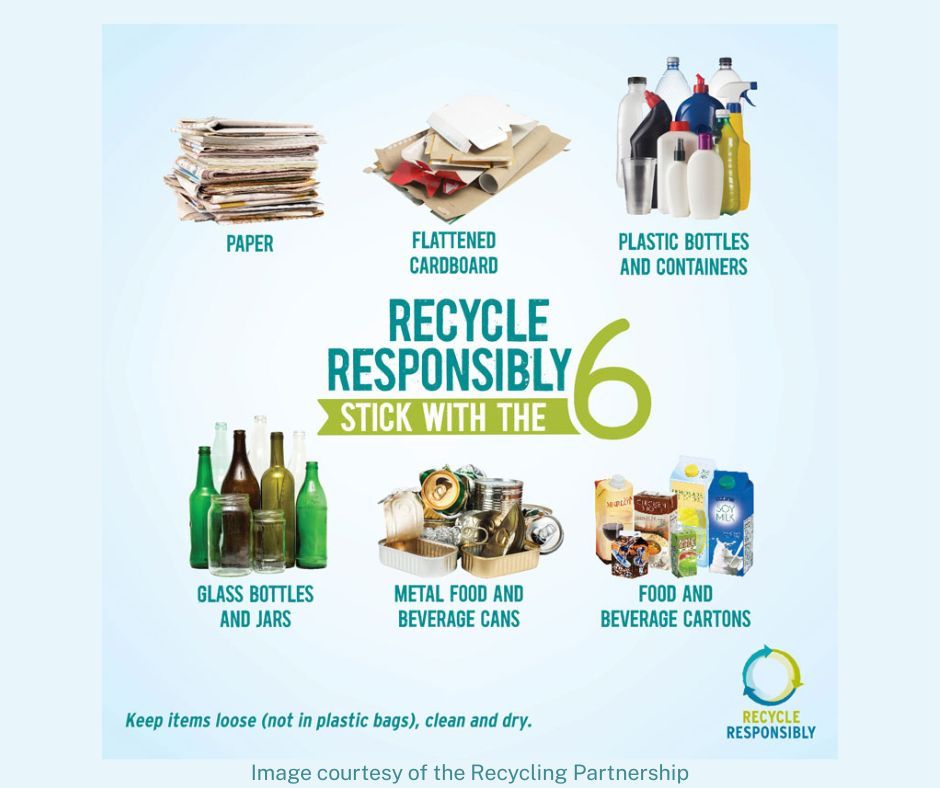
In the spirit of helping lower recycling contamination rates, we are sharing here the City of Houston’s recycling guidelines. (If you are not a resident of the city of Houston, links to information about some other area city’s recycling programs are at the end of the article)
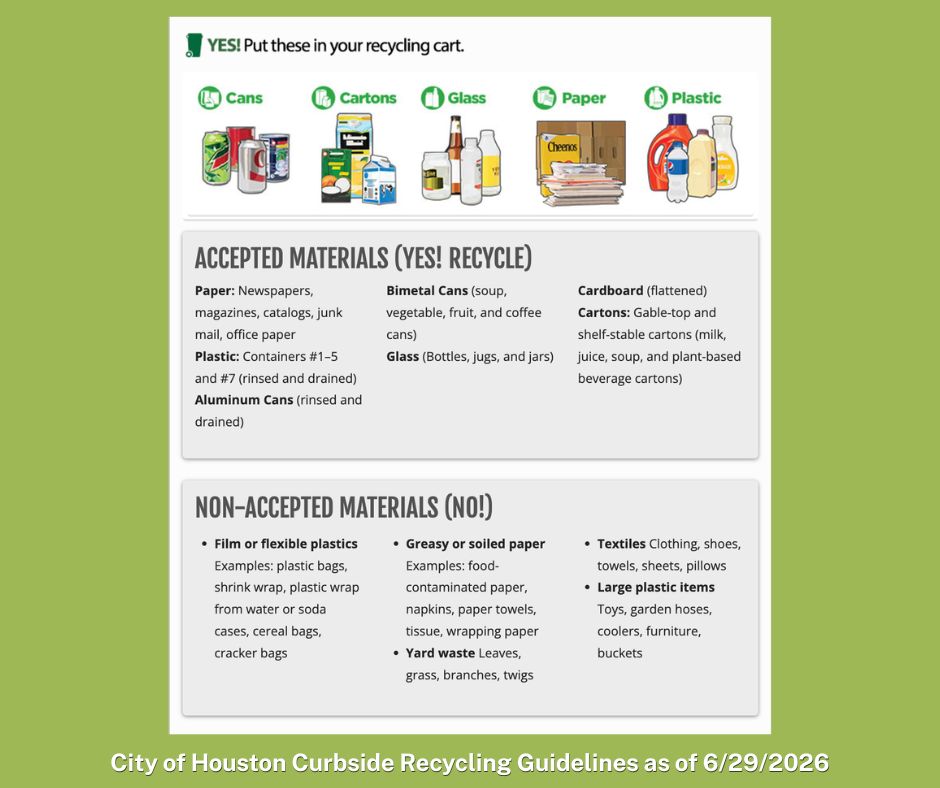
Do put in your curbside bin:
- clean, dry paper
- flattened cardboard, emptied of any packing peanuts, air pillows or other packing material
- aluminum and steel cans (empty, but do not crush); no scrap metal, wire hangers, etc. Just cans.
- plastic bottles and jars (empty and clean, but do not crush; only hard plastic containers, no plastic film)
- glass bottles and jars only (empty and clean); no drinking glasses, window glass, etc.
- cartons (empty and clean) such as milk cartons and soup and juice boxes (straws removed and put in the trash), not the plastic juice pouches
IF IT IS NOT ON THE ABOVE LIST, IT DOES NOT GO IN YOUR RECYCLING BIN.
DO NOT BAG YOUR RECYCLABLES.
Do NOT put in your curbside bin:
Batteries
Propane tanks
Film or flexible plastic
Any other tanglers such as garden hoses, wire hangers
styrofoam
textiles
hazardous materials
food waste
tarps
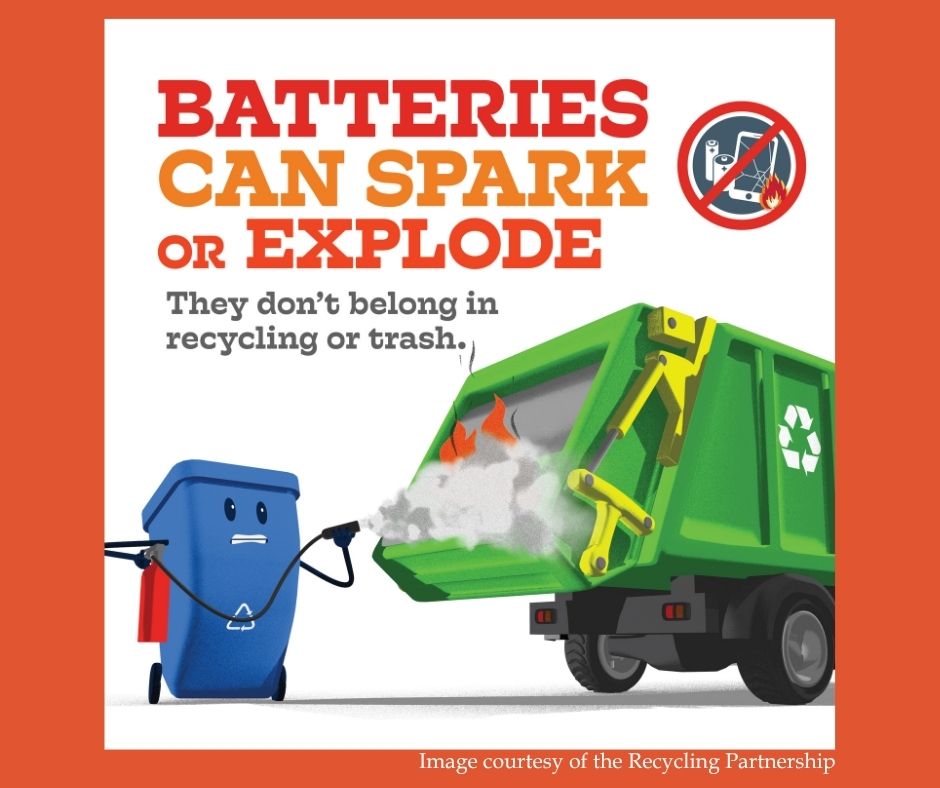
FCC’s Rodriquez pointed out that if the city were to focus on eliminating the contaminants that have the most financial impact first, propane tanks and batteries would be the top contaminants to focus on because those cause explosions and fires and are dangerous to the workers. Batteries, in particular have led to multiple fires per month at the FCC MRF. Tanglers, such as plastic bags and wires, though not hazards, also have a huge financial impact because their presence shuts down the equipment for extended periods of time and can damage it.
Understanding how a MRF operates can help Houstonians understand the importance of following the recycling guidelines. Though this short video about how recycling is processed at MRF was not taken at the FCC facility, and some things will be slightly different, the general equipment and process is representative of what happens at FCC and will allow you to understand for example, when you see the screens that the recyclables go across, why it is so important to keep plastic bags and other tanglers out of your bins, or, when you realize that eddy currents are used to blow aluminum cans where they belong, why it is important not to crush them, or, when you see the front end loader scooping up vast mountains of recyclable materials on the MRF floor, how important it is to keep lithium batteries out of the recycling. Many MRF fires start when a front end loader hits a lithium battery buried in mounds of paper and plastic, causing it to break and spark. These fires, started even from the tiniest batteries, are very hard to put out. A fire at the ITR MRF in Northeast Houston in November 2020 that was thought to be started by a lithium battery on the tipping floor took 35 firefighting units and 12 hours to put out.
While the city and FCC try to do their part to lower Houston’s contamination rate and increase its recycling rate, keeping contamination out of the recycling stream ultimately lies with all Houstonians. So please, refresh your understanding of the recycling guidelines annually, at the minimum, and put only the items on the acceptable list in your bins. Help educate your friends, families and co-workers by sharing the recycling guidelines with them.
Live in another city in the area?
All cities have information about solid waste and recycling options in their communities on their websites. Take a moment to look yours up.
Bellaire: https://www.bellairetx.gov/
City of West U: https://www.westutx.gov/336/
Galveston: does not offer curbside recycling as a city service. It has a drop-off eco-center and various other item specific drop-off locations in the area and residents can pay a third-party contractor to have a curbside service. https://www.galveston.com/faq-
Kemah: https://www.kemahtx.gov/547/
The Woodlands: https://www.