Movie Review: See Gaslit and find out what is happening in your own backyard
by Susie Hairston
For those of us who live in the petrochemical corridor which is the Houston-Galveston-Port Arthur – Corpus Christi Gulf Coast, this is a must see film about our region and our communities. It makes us see our own backyard in a different way.
The film follows Jane Fonda on an odyssey through the hell that is oil and gas production from the Permian basin where oil and gas is extracted across Texas along the pipeline routes to the Gulf Coast where it is processed, refined, turned into plastics, or made into LNG to be shipped overseas.
The film focuses in on the battle to stop the build out of Liquified Natural Gas (LNG) infrastructure. LNG is made by supercooling methane to make it easier and safer to transport overseas. In the communities in which they are located, LNG facilities create pollution, including nitrogen oxides, sulfur dioxide, and particulate matter, endanger the health of area residents, and produce a lot of greenhouse gases, all so we can send our domestically produced energy elsewhere, driving up prices at home. Communities living near LNG terminals have higher rates of respiratory disease, asthma, heart disease, and cancer.
The film presents us with facts about oil and gas (the US is the number one exporter of LNG; 1 in every 5 deaths worldwide is related to air pollution from burning fossil fuels, etc. ), but it focuses in on the communities that have been sacrificed to oil and gas expansion — the individuals whose lives have been adversely affected, but who still find the will and the power to bond together with others and fight back for the land and the communities that they love, and for all of us.
We meet local community members turned activist in response to watching their homes be destroyed and their families and community members suffer and die. We meet fishermen, ranchers, farmers, former oil and gas workers and more. From Methane Hunter Sharon Wilson who uses a special kind of imaging equipment that allows her to see and film methane emissions in the Permian Basin that cannot be seen with the naked eye to Goldman Environmental Prize Winner Diane Wilson, who fought and won a lawsuit against Formosa Plastics for polluting the bay where she lives, to young activists in Corpus Christi fighting LNG build out, to indigenous activists Juan and Christa Mancias in Brownsville fighting against Space X’s environmental destruction and LNG build out, to fisherman Travis Dardar, a climate refuge from the Isle de Jean Charles, fighting for his new home and the rights of fishermen to earn a living, to former special education teacher, Sharon Lavigne in St James Parish, Louisiana, who successfully stopped a $1.25 billion plastics manufacturing plant from being built in her parish, we meet local heroes, hard-working people, who just wanted to live their lives in their beloved communities, but stepped up when those communities were being destroyed.
In addition to putting us in the shoes of those faced with the poisoning and destruction of their communities,, the film also does a really great job of visually showing us the immensity of this behemoth that is the petrochemical industry.
It shows us the tremendous wastefulness of this industry — the clouds of methane leaking from the storage tanks in the Permian, the incessant flaring, and the 1.5 – 2 million gallons of gas leakage that occurs each year from the pipelines that carry the gas from the Permian to the refineries and LNG terminals on the Gulf Coast.
The film also does a great job with graphics and explaining how fracking works and how LNG is made.
It also touches on the fact that state and federal agencies that are supposed to protect individual rights and human health, instead side with industry, allowing it to pollute with impunity. As Sharon Wilson, Methane Hunter, says, “We witness crimes in the oil field. Crimes against humanity, crimes against workers. I feel like we are witnessing the end of humanity out here.” But despite all the video evidence she has of the billowing clouds of methane the industry is releasing, regulatory agencies do nothing.
The film is filled with the sadness of lives lost and what a young activist described as anticipated grief — wondering who you will lose next. But it is also filled with the ironclad faith of Sharon Lavigne of Rise St. James and the unbreakable will of so many, like Diane Wilson, who stand up for their communities It is dotted with humor and filled with solidarity and community — which Fonda and the activists in the film hold up as the way to win against all the power and the money and the destruction.
The documentary has been traveling around the country, and everywhere it is screened, it is followed by a discussion with local community members and environmental organizations who are on the ground in their communities. The film is about the power of forming coalitions, of working from the grassroots, of fighting with your neighbors for your own community and helping others fight for theirs, and so it doesn’t just show that or talk about it, but actually brings community together with local grassroots activists and community leaders at the end of each screening.

At Tuesday night’s screening the panel discussion included: David Leffler, Editor and Senior Staff Writer, Public Health Watch; Elena Bruess, Contributing Writer and Audio Producer, Public Health Watch;Yvette Arellano, Founder/Director, Fenceline Watch and indigenous activists prominently featured in the film: Christa and Juan Mancias.
The post film-discussion elaborated on issues brought up in the film and how they relate specifically to our community.
Yvette Arellano from Fenceline Watch followed up on the brief point the movie made about the special hazards these petrochemical facilities presented to the larger community when there is a hurricane or flood or other disaster. She told us we have 694 chemical facilities in our area, 252 of which are called Risk Management Plan or RMP facilities because they are high hazard chemical plants, that would put millions of people at risk if there were some sort of leak, etc. She said the blast radius for some of these facilities is 25 miles, which would encompass downtown Houston and the theater we were currently sitting in. And beyond the horror of this information, she went on to tell us that information about these risk management plans are not made readily available to the public because doing so is considered a national security risk.
This harkens back to a moment in the film when Melanie Oldham from Better Brazoria discusses an explosion and fire at a Freeport LNG in June 2022. No information about what had happened, what the hazards to the community were, etc was released to the surrounding community until November of that year, and, even then, 50% of the information was redacted.
When Yvette was discussing the RMPs, Elena Bruess, a journalist who has sought access to these RMPs explained that community members can access them, but by appointment only, at reading rooms. In Houston, you can view the RMPs at the Department of Justice Reading Room, but you must have an advance appointment where you specify exactly which company’s RMP you want to see; you may only look at 10 at a time and you are not allowed to take photos of the documents; you can only take notes with a pencil and paper.
David Leffler, the moderator from Public Health Watch pointed out that though these facilities and their horrible impacts on human health and community can seem to be far away from us at the River Oaks Theater, the truth is that, even though we don’t see it, and are not impacted as much as the communities who literally live with it in their backyards, the fact is that we live next to the largest petrochemical complex in the nation (the second largest in the world), it is negatively impacting us all.
Christa Mancias emphasized the importance of building coalitions and working together with and for communities. Christa said that early on in their fight for their community, she and her father made a pledge to go and really get to know other communities that were facing the same challenges. And they kept that pledge, traveling to Port Arthur and St James Parish and other places to learn from, empathize with, fight alongside, and build a larger community of activists.
In keeping with her focus on coalition building, she discussed a successful strategy they have used to stop LNG terminals from being built in their community — defunding campaigns. These campaigns involve pressuring banks that finance fossil fuel build out and insurers that insure the projects not to do so. This type of pressure would not work if there were not many voices asking the banks and insurers to step away — grassroots community building works! She says that the result of working with South Texas Environmental Project on these defunding campaigns has been that one of the LNG companies has decided not to proceed with their facility; of the two other proposed projects, only one has started construction.
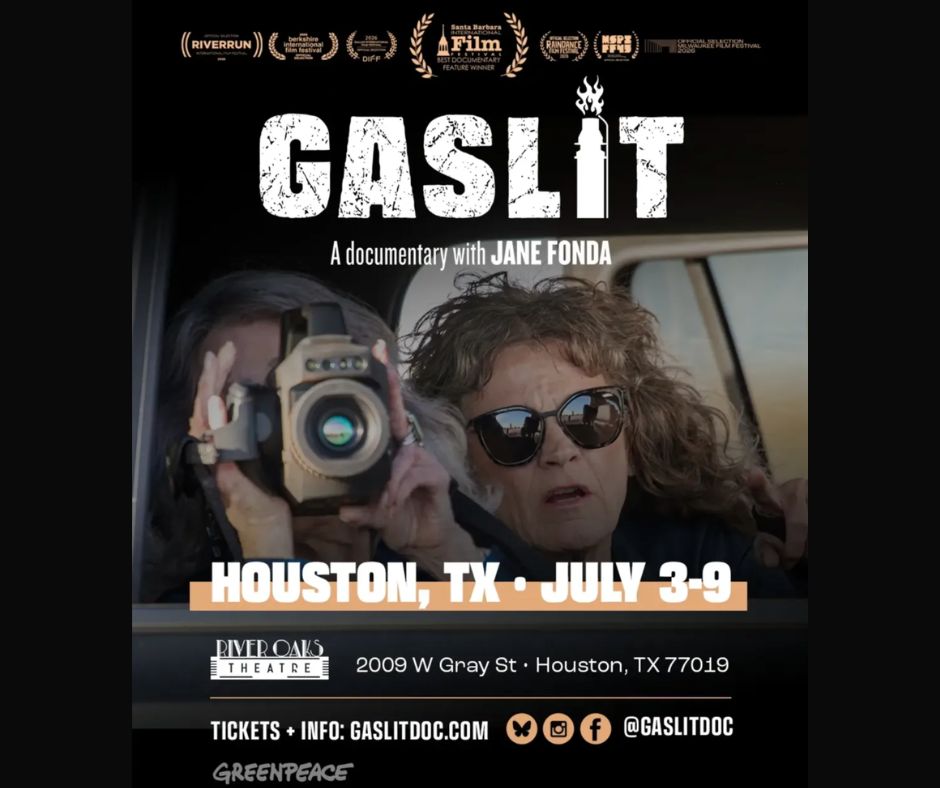
There is still time to do some coalition building: Gaslit is screening tonight, Wednesday, July 8th at 7:45 p.m. and Thursday July 9th at 12 p.m. at the River Oaks Theater. Both shows will be followed by a panel discussion with local activists presented by Texas Campaign for the Environment. Can’t make it? Look out for its streaming release after the national screening tour is over, and, in the meantime, get involved with some of our local grassroots activists.