Bearing Witness: Texas extreme weather survivors share their stories with fellow community members and elected officials at the Extreme Weather People’s Hearing

By: Susie Hairston
Everyone in Texas is affected by extreme weather events such as droughts, heat domes, hurricanes, winter storms and floods, but some people are more prepared to deal with both the impacts of the extreme weather and the recovery after it has passed than others.
We are all aware that these extreme weather events are becoming more frequent and more destructive due to climate change. Many of us have lived through at least several of these events. And yet, action to mitigate climate change or to adequately support vulnerable citizens during and after these events is either slow or non-existent. As US Representative Sylvia Garcia said, “We don’t talk about climate issues and extreme weather enough and we need to be doing it more loud and clear — especially with today’s federal government.”
But even when climate change and extreme weather are talked about, often people and their individual experiences and suffering are buried under large numbers such as “Hurricane Harvey was a 160 billion dollar disaster or 48% of Harris Count residential units were damaged during hurricane Ike or at least 139 people died during the Guadalupe River Flood in July 2025. Though those numbers are important, they can cause us to lose sight of the individuals who lost their homes or lost their lives.
Further, some people do not have the same resources as others to both weather these extreme events and recover from them. As City of Houston Controller Chris Hollins said, “When these storms come they don’t ask you if you are rich or poor or Republican or Democrat before they uproot your whole life, but we know those who are less fortunate will be most impacted. They can’t just say, ‘I’ll call the roofer on Monday and it will get handled or go stay at my vacation home until this over.’”
Liza Powers of the Bullard Center for Environmental and Climate Justice, and one of the testifiers at the Extreme Weather People’s Hearing explained, “Flood fatalities are not random —the infrastructure that fails people has a pattern. Racism shapes who gets rescued and who gets left behind.” After her experience with multiple storms, she decided to focus her research on flooding, “The research confirmed what my life already knew — when this administration guts EJ policy — it is not making an abstract policy choice: it is deciding whose lives are expendable.”
That is why the Extreme Weather People’s Hearing, hosted by Climate Action campaign, with many local partners*, on May 30th was so important. The hearing created a space for the voices of fellow Houstonians and Texans who had lived through the worst of some of these disasters to tell their stories to fellow Texans and a group of elected officials.
The elected officials who attended were there as receivers of the stories of suffering — witnesses who could carry those stories and policy suggestions to Houston City Hall and the Texas Legislature and the federal government to instigate action. Texas State Senator Molly Cook said, “We promise we will work inside the halls of power, and we will work outside as well to invite community members into the decision making and show them tools on how to organize.”
The stories came from people of all ages and diverse communities scattered across the Houston area and Texas, and encompassed a range of extreme weather from Hurricanes Ike, Harvey, and Beryl to floods such as the Guadalupe River flood to the Derecho to Winter Storm Yuri to extreme heat, and despite the different experiences, these stories did share some common themes — feelings of fear and helplessness during and after the event, a celebration of community and family that came together to help in the absence of government support, an ongoing feeling of PTSD any time there is a heavy rain, insurance companies that either wouldn’t pay at all or paid, but not nearly enough, a sense of abandonment, of not being valued as a fellow human, a sense of the inescapability of these events — coming one right after the other before you had recovered from the previous one, the sense that these events change lives forever, the fact these events, as Tom Ehlers, Galena Park Fire Chief succinctly put it, “take a physical toll, a mental toll, and a financial toll,” pride in individual and community resilience but a desire for government to take a more active role so individuals don’t have to fend for themselves, feelings of luck and gratitude because your situation wasn’t as bad as someone else’s, the fact that financial costs are not just the large dollar amounts required to repair the damage from the event but all the constant year round spending to prepare for each of increasingly frequent events in advance, the inability to work either because you could not get there or because you could not work remotely because you had no power, the mounds of often incomprehensible paperwork needed to get help.
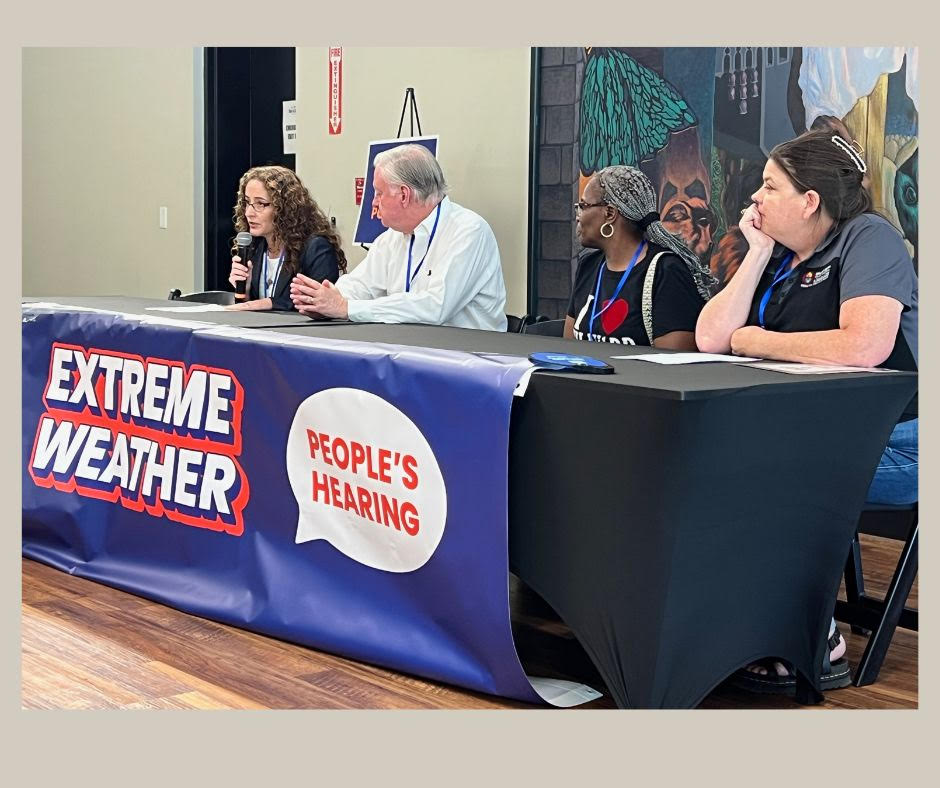
Extreme Weather Stories:
Amy Zackmeyer from New Economy for a Resilient Houston told her story of going out with chainsaws and spending all day helping people clear trees that had fallen after one storm only to return home to her own house that had no lights, no A.C., and a limb on the roof. “#Houston Strong sounds good but it doesn’t feel good the fifth or sixth time you have to be Houston strong.”
Doris Brown, Co-Director of Community Research, Organizing, and Development at West Street Recovery, said, “Harvey almost killed me. I was sitting in my house and folding laundry. I hear some water running in the back and then I hear this horrible crash. When I get up to see where the water is coming in I see the ceiling has collapsed. Then I see water bubbling up in my bedroom.
“Some of my neighbors come and put things on top of things to try to save some of it. Even now, when I think about it, I get upset — I didn’t get any help until I met West Street Recovery.
“People are losing their lives. I myself now suffer from PTSD. When it starts raining and I see lightning, I get scared and hide in the closet in the center of my house because I’m thinking I’m going to be flooded again. It doesn’t even have to be a hurricane — water is running down my street in a heavy rain. . . This plays havoc with my physical being. I have COPD. I don’t know what is going to happen. If we don’t fight together, there is no telling what is going to happen. . . we need a fully funded FEMA and NOAA.
“Insurance is getting so hard. They asked me, ‘Did the water come up or come down. What’s that got to do with it? I flooded. I paid into the system, and when I needed help, I didn’t get it.”
Dondi Voigt Persyn, who lives in the Texas Hill Country, went searching for missing people after the Guadalupe River flooded July 4, 2025. Dondi explained, “One thing I noticed was the personal belongings strung across the landscape – photographs and jewelry and clothes, exposed and vulnerable like a second pain. I started gathering these things and started a facebook group that turned into a community of nearly 60,000 people. People from across our country and the world helped us return belongings to their rightful owners. That first month seemed like a couple of days — my husband said it was weeks. On the 30th day we got a warehouse, and mothers and grandmothers developed a system, and we organized and returned things to families. Eleven months later, I am still doing the work. Along the way I became a steward of people’s stories. They represented the time before the days before we knew something was going to happen – the father who survived on a rooftop with his 7 and 9 year old and is still in line to this day for mental health support. Volunteer firefighters . . . “
Small Business Owner Beata Lerman shared her story of losing power for 10 days at her chocolate shop as a result of Hurricane Beryl. “There was extreme heat and no electricity. I lost tens of thousands of dollars of chocolate and ingredients. I know other restaurant owners who lost upwards of $300,000. We lost our roof and our walls got soaked and were covered in mold. When I got back from being displaced with my daughter, we were just sitting there in 100 degree heat with walls covered in mold.”
Richard Zdunkewicz’ wife’s family had property on the Guadalupe River for 80 years. “July 4th we woke up to flood waters rising extremely fast at 3 a.m.— the water was only a few feet from us. I woke my wife and daughter and said we have to evacuate. . . . We had to climb up trees — large debris nearly struck us. Those trees were our only refuge.”
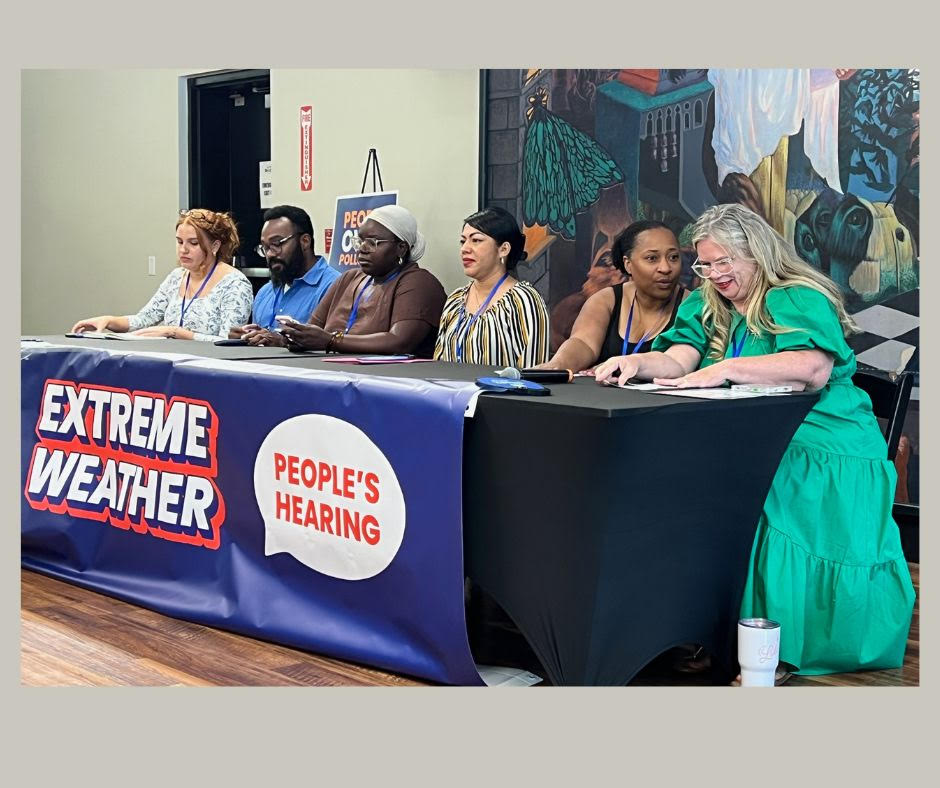
Antonieta Cadiz moved to Texas in 2013. In 2017 she and her kids were rescued from their house. Harvey “destroyed the first floor of my home and displaced us for more than a year. Our house sat under water for 8 days.” When they returned they found a devastated home overrun with mold, making it completely uninhabitable.
Antoineta points out that the damage from extreme weather is “physical, financial and psychological. Without flood insurance we had to take a loan – we are still paying it off. Our insurance has skyrocketed by 40%. Every single time it rains intensely, I relive the storm and live in constant fear because our weather is becoming more extreme, but we are not acting. I see my children so terrified — I couldn’t protect them. That is why I am here today. No matter how much people in Washington want to deny our experiences with extreme weather they are undeniable.”
Sandra Edwards shared “In 2017 Harvey took over my house. It was like I wasn’t there — I didn’t think I was going to live but somebody came and got me. When I did get back to my house, I had no house — it was like a freight truck had hit my house — my walls had shattered, my floors came up, half of my roof was gone. and it was like a swimming pool inside my house. I am today — how many years later? — still suffering.
“If it weren’t for West Street Recovery I would be living under a bridge — they helped me as best they could to rebuild. I have been hit 4 more times since Harvey. How much can a person take? How long does it take for someone to see we need help? . . . how do we get back to normal? How do we get to live as people after you go through so much and you don’t have help?
Sade Hogue has lived through 3 hurricanes: Ike, Harvey, and Beryl. She said, when Beryl happened, “I left work, and I saw the storm coming. As I was driving down 59 the storm was following me. On one side of my car the sky was light and on the other, dark , and I learned that I was in the eye of the storm. I had a condo in Crosstimbers and was in the process of getting out to have it repaired after Harvey. As I turned in at the gate, a tree fell inches from the front of my car. I got into the condo – the power was already off.” She told us, she called her husband to check on him, “He said, ‘Baby are you sitting down?’ He said, ‘a tree just fell through the roof of our bedroom.’” She asked to facetime him because she didn’t believe him — she saw sun through the ceiling, She asked her husband and kids to go look out the front to see what was happening, and as they got off the bed to go to front door, the tree fell all the way through the bedroom ceiling landing where they had been.
She explains, “What upset me was, I just had a devastation, and then I had another. Technically I was homeless. I went to Washington, DC and talked to FEMA personally.”
When she went, she spoke up for all Houstonians in her shoes, “A lot of us in Houston are one paycheck away from disaster. We have to live in our home though we have no power, no food, some couldn’t flush their toilets — we had to say that our home was livable because we had to live there, but it isn’t really livable.” Her advocacy resulted in FEMA granting $750 in immediate relief to everyone in Houston whose homes were devastated.”
Suggestions for improved resilience and recovery:
In the course of telling their stories, many of the participants incorporated solutions to some of the problems of disaster and recovery, and the elected officials weighed in with their thoughts on how to improve our resilience.
Tom Ehlers, the Galena Park Fire Chief who has been through many extreme weather events and chemical disasters as a first responder said, we all need to work together to raise our voices to get what we need. “It’s important for NOAA, FEMA, and EPA funding to be available: prediction saves lives, mitigation saves lives, enforcement saves lives. I’m tired of watching people die. We have to solve this now.”
Jalen Wilson who lived through Hurricane Harvey as an economically vulnerable child and Winter Storm Yuri as a college student realized when his apartment temperature dropped into the 40s that even as a student with the gravitas of an Institution like UT behind him, “I was still alone.” His solution? “We need climate solutions now — we need a fully funded and staffed non-partisan FEMA.”
Congresswoman Garcia is in agreement that we need functioning federal agencies, specifying, “We need to fight to keep agencies that provide critical information to us about when and where storms are coming, like NOAA, fully staffed and functional.”
Congresswoman Garcia also spoke about the dangers of extreme heat, explaining that extreme heat killed more people than hurricanes and flooding combined. She advocated for mandatory work breaks for construction workers.

Several of the participants advocated for resilient infrastructure Amy Zachmeyer said, “We need to build resilient infrastructure rather than expecting Houstonians to take care of themselves.” The city needs to be resilient “so Houstonians won’t have to be.”
Beata Lermank, speaking as an advocate for small businesses, said “We need strong electrical infrastructure and backup power. Business owners should not lose their business because power fails.”
Several people mentioned the need to have a back-up for the grid. US. Representative Garcia was in agreement with those participants and is advocating for Texas joining the national grid.
RIchard Zdunkewicz, who lived through the Guadalupe River Flood, recommended, “Rural counties need much better flood warning and better emergency planning.”
Kylie Nidever who saw 28 of the 33 homes in her rural community get damaged and helped her neighbors recover urged, “Towns like mine deserve more than survival after disaster. Rural communities should not be left behind when the next disaster strikes.”
Dondi Voigt Persyn , who collected and helped return possessions to victims of the July 2025 Guadalupe River Flood, asks, “What can you do? Have the tenacity of 8 grandmothers — know how to spend money and not waste a quarter.”
Shaunta Floyd, speaking of her experience in the aftermath of Hurricane Beryl, was frustrated by a lack of communication. “We kept being told ‘the Power will be on tomorrow’ but it never was.” She was concerned about lost wages because she was a remote worker and couldn’t work because she had no power. She points out, “No one had clear direction or help. We need better direct support, resources.”
Andrew Barley helps rebuild homes after storms. He advocated that “equitable drainage infrastructure is necessary for the city as a whole. Residents of Northeast Houston have waited long enough for adequate protection.”
He also advocated for a better recovery process: “I started this year on a project paid for by a grant that could help with 24 houses but that had to be done between January and April. They had to be Beryl only. There are so many houses out there waiting, including homes from Harvey, I have had two people die while working on those 24 homes. Our system, as it stands, is unsustainable, not equitable, and doesn’t serve Houstonians who most need it.”
Sharon Underwood, who has suffered through multiple disasters — displaced when her apartment building was flooded almost to the roof during Harvey and displaced again for a week when the pipes in her apartment building burst during Yuri — said, “Recovery doesn’t end when the storm has passed. Survivors need long term support.”
Sara Cinco from Healthy Gulf points out, “We often focus on flooding homes and power outages, but not on another threat – toxic chemical releases triggered by these events. During Harvey, dozens of companies reported spills. It’s not an abstract policy issue: in Channelview people live and work there. The lesson from Harvey is clear: we need a stronger requirement for chemical companies to develop resilience. Residents need timely, accurate info when incidents occur; we need community involvement.”
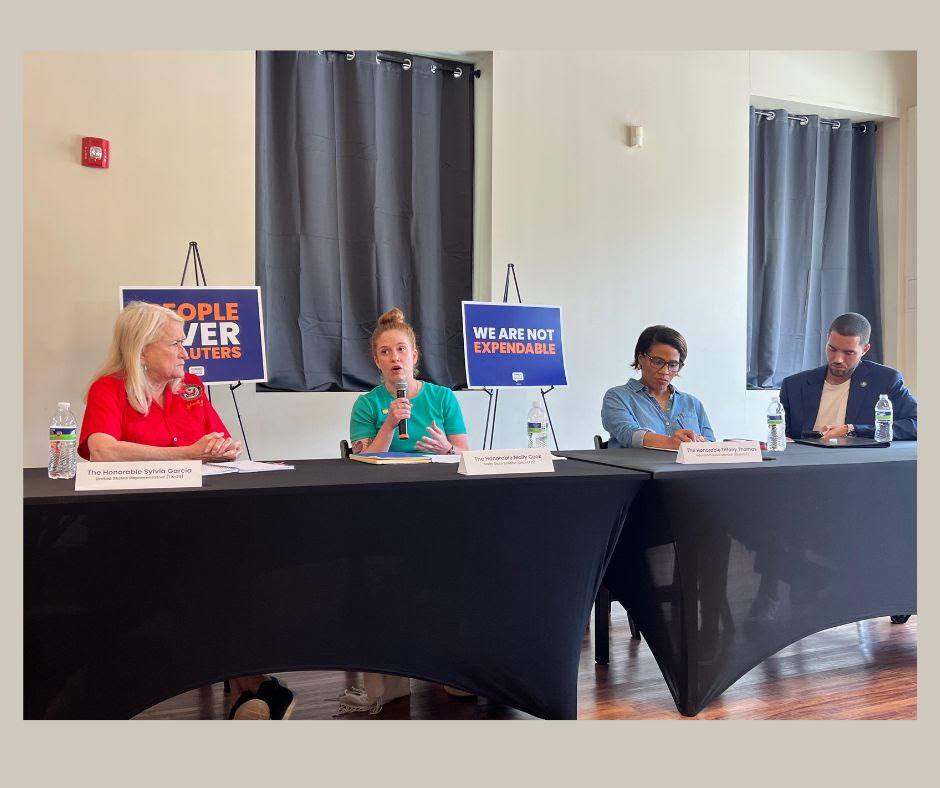
US Representative Garcia said every single level of government needs to be involved in the solutions. She also said we need to watch out for data centers which are huge energy users.
She is a strong advocate for disaster relief coming straight to the city. “When it goes through the governor’s office, it gets layers and layers of red tape, After Ike, West Texas was slated to get more money than Houston,” even though, as she told them at the time, “You all didn’t get enough wind to fly a kite.” At the same time she said that if the money does go to the city, we have to make sure the money is managed equitably.
Chris Hollins, after explaining that unlike other Texas and US cities under significant threat of disaster, the City of Houston does not have adequate funds set aside to deal with an emergency. “Houston has to understand there is not a cavalry coming to help us. We need to learn how to be self-reliant — we have to focus on the city’s budget — we have to have our own plan, our own resources. We have to have a longview, not just one hurricane season, but years and decades into the future.”
US Representative Garcia echoed Hollins when she said, “We need to realize that the money to deal with extreme weather is not going to come from the federal government. We have to be realistic and adequately fund the rainy day fund, and we have to figure out how we will fund it. With a fee? with a tax?”
Molly Cook reminded us of a power we all have to help with disaster recovery, “you are voting for disaster recovery every time you vote – every single election.”
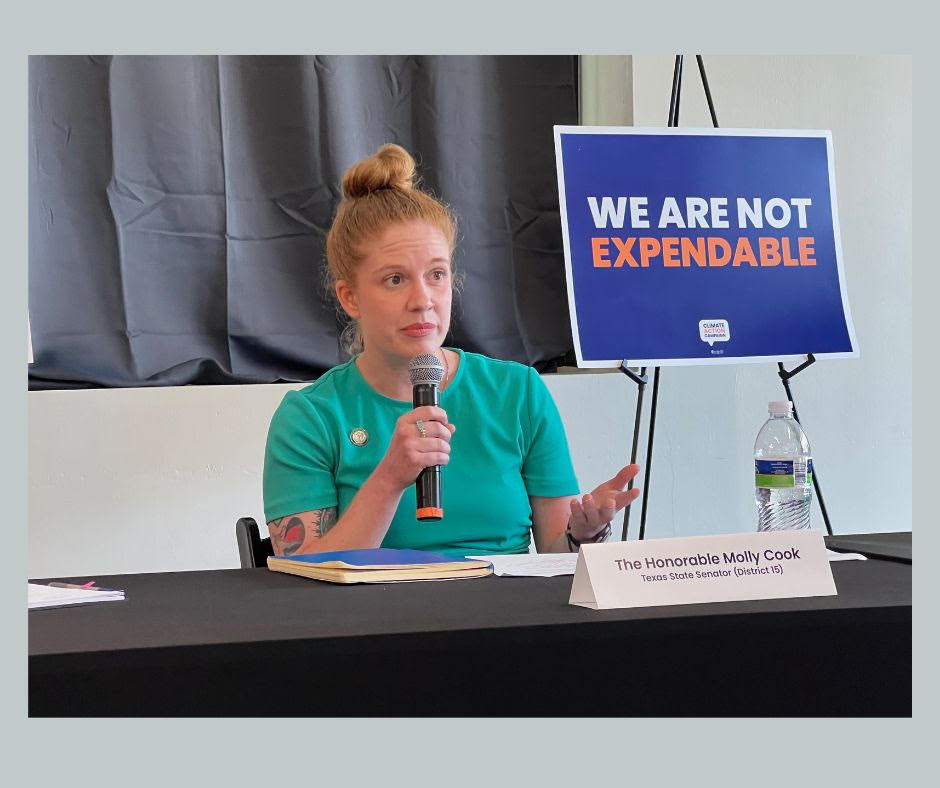
After we have heard all these stories, what can we do besides bear witness? As Congresswoman Garcia said “Tenemos que hacer ruido.” We have to make some noise. We have to talk about climate change and extreme weather. We have to advocate for mitigation and resiliency.
We have to emulate Sade, who went to Washington and got aid for people who had lost homes in her community. She said, “I live in Settegast — one one of the lowest income areas. We have disasters, pollution . . . the highest childhood asthma rates around, cancer, COPD. How many compounding disasters can we take? I am glad I can speak — so I can stand up for all of us.”
*The Extreme Weather People’s Hearing was cosponsored by Air Alliance Houston, Climate Power, Extreme Weather Survivors, Fossil Free Media, Green Latinos, The Parents’ Climate Community, PoderLatinx, Sierra Club, Texas Campaign for the Environment, Texas Chispa, Texas Physicians for Social Responsibility, Union of Concerned Scientists, and West Street Recovery.