The 2026 City Nature Challenge results are in!

by Susie Hairston
The results of the 2026 City Nature Challenge (CNC), which took place from April 24th-27th, are in! The CNC is a fun global community science event that gets people outdoors to photograph local wildlife and contribute to a worldwide effort to better understand biodiversity. It generates valuable community science data on biodiversity that supports conservation, planning, and environmental decision-making.
As always, the Houston-Galveston team members were major contributors. Team H-G made the 11th highest number of observations of any team in the world and observed the 6th highest number of species.
This annual global event started as a competition between San Francisco and Los Angeles. Begun and coordinated by the California Academy of Sciences and the Natural History Museum of Los Angeles County, it rapidly expanded to become a global competition, and has now morphed into a collaboration between more than 100,000 citizen scientists across the world. As such, it serves as an inspiring example of international cooperation, which we can continue all year long. The event is an opportunity to collect a lot of data from across the world all at the same time, but data is still needed throughout the year, and each of us can contribute by photographing and uploading photos of the natural world around us as we go about our days.
The data collected during this challenge will be used for a variety of important projects. Past data has enabled scientists to understand by looking at the pattern of where a specific flower was living and where it wasn’t, that that species relies on fires to be able to survive and thrive. Data from the challenge is used to monitor the presence and movement of endangered species in urban areas, which helps inform conservation plans. CNC data also helps researchers map the spread of invasive species and use that to stave off their damage. An example of this is that observations of destructive pests such as the emerald ash borer has allowed ecologists to see where they have expanded their range, giving scientists the opportunity to protect trees in these areas.

Texas Nature Trackers, a program of the Texas Parks and Wildlife Department (TPWD) uses data from the CNC to map the distribution of species that TPWD has designated as Species of Greatest Conservation Need (those that are most vulnerable) in urbanizing areas. This mapping enables biologists to keep track of changes in each species’s population numbers and keep abreast of the health of specific Texas ecoregions.
Houston Audubon uses data about bird populations from the CNC to help them determine how best to manage coastal bird habitats on the Gulf Coast.
Texas cities and counties in our region can use CNC data to identify the locations of vulnerable plants, nesting birds, etc. so that governmental entities can adapt landscaping practices, protect migration corridors, and devise other adaptation measures.
If you didn’t participate in the City Nature Challenge, but want to help collect data about what plants, animals, and fungi live around you, and get to find out for yourself what that unusual spotted insect or beautiful lacy plant you have always wondered about is, download iNaturalist on your phone, sign-up for an account, and start snapping photos. You won’t want to stop. If you wanted to participate in the City Nature Challenge this year, and didn’t get to, mark your calendars now for next year — the observation period will be from April 30 – May 3, 2027.
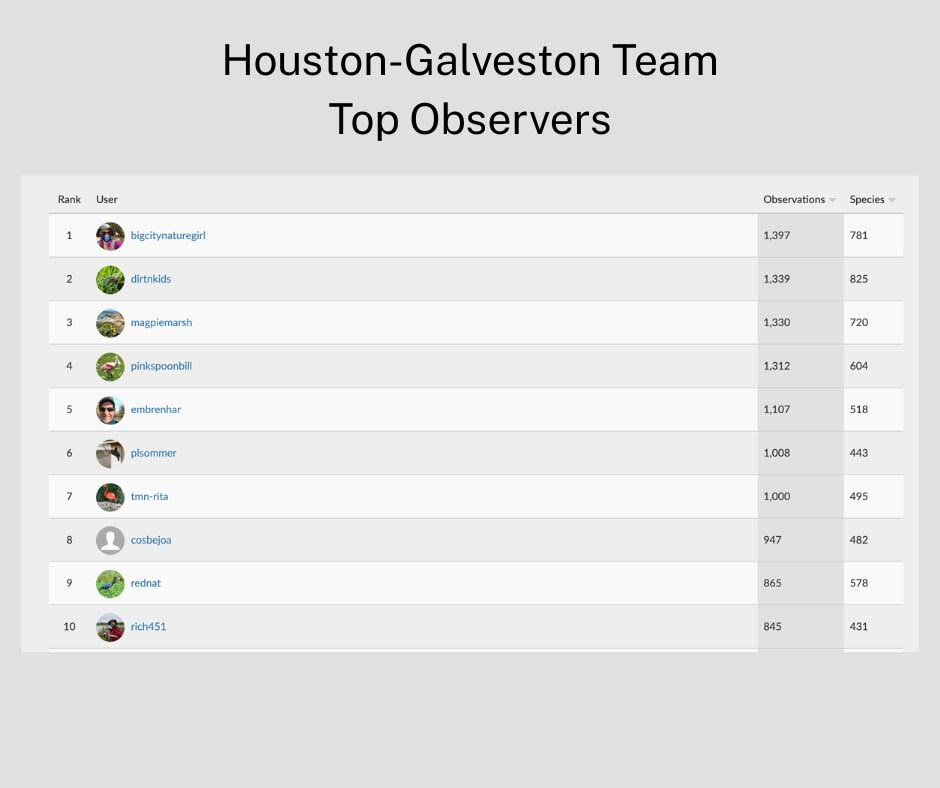
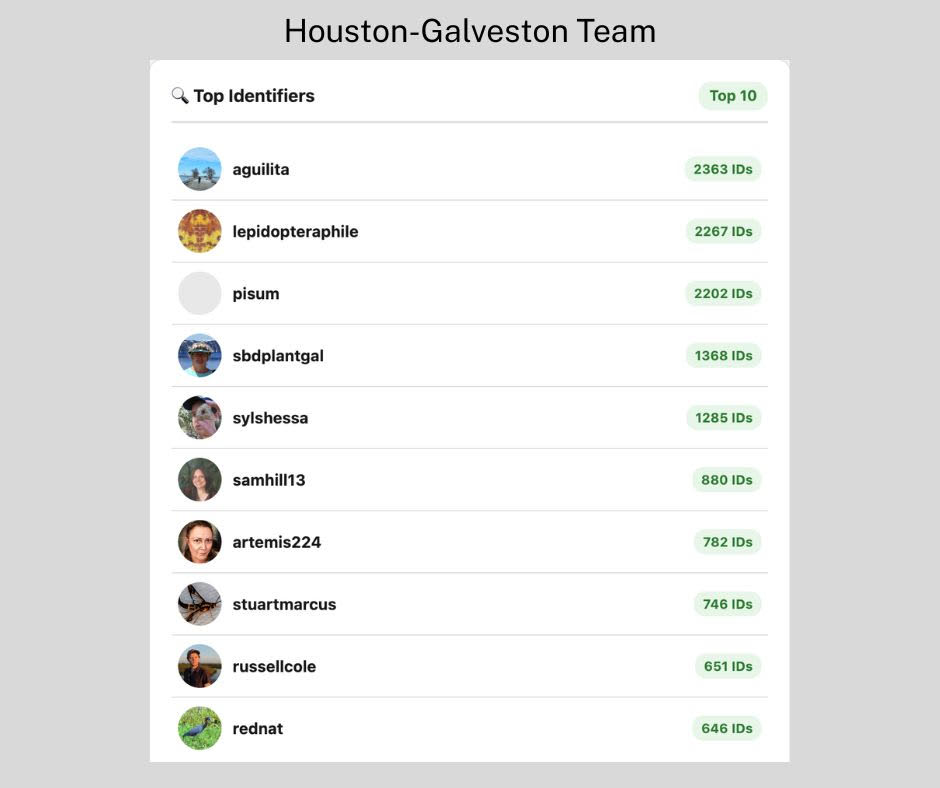
Highlights from the Houston-Galveston region: The top ten most observed species in our area during the challenge were: Common lovebug, Pinkladies, firewheel, southern dewberry, Northern cardinal, straggler daisy, brown anole, American alligator, Asian Lady Beetle, and Green Anole. We had a global first sighting: Observer rednat was the first, both locally and globally, to upload Diaspis digna, a species of armored scale insect, on iNaturalist. For more information on other observations, check out the Houston-Galveston infographic.
Globally, 754 cities in 61 countries participated, 70 species new to iNaturalist were observed, and 5688+ endangered species were documented. Check out the global infographics for more of the many highlights from around the globe.
Thank you to everyone who participated in and contributed to this enormous and important global citizen science project — the observers and expert identifiers without whom we could not have collected so much information to be used to better understand the biodiversity in our region.