Now is a great time to weatherize to save energy and money before the heat of summer hits: find out what you can do and learn about weatherization assistance programs in our area
by Susie Hairston
Weatherizing your home involves improving its energy efficiency and protecting it from heat, cold, and moisture. A variety of strategies from the easy and inexpensive to the complicated and expensive are available to make your home more comfortable, more resilient during extreme weather events, and less expensive to heat and cool.
In addition to lowering your energy use and saving you money, weatherization has many benefits:
- it keeps your home cooler in the summer and warmer in the winter
- it improves your indoor air quality
- it reduces your risk of breathing issues and heat stress,
- it lessens heat-related exacerbation of chronic diseases such as diabetes and heart disease
- and it improves your mental health.
Weatherizing your home doesn’t just benefit you, it benefits our larger community. Home weatherization — doing things like insulating your house — means that you will use less fossil fuels to heat and cool your house, thus reducing your greenhouse gas emissions. The lower energy demand from weatherized homes also helps take strain off the grid during the highest demand in the heat of summer and the deep freezes of winter, helping lower the risk of grid failure.
Though weatherizing does have upfront costs, over time, the tighter and more energy efficient your home, the more money you save on energy bills. According to the Department of Energy, American’s can save on average $372/year. For families who are economically vulnerable, weatherization can make the difference between living in the heat of Houston without A.C., and thus suffering health consequences, or being able to afford to cool their homes in the summer.
In order to maximize your weatherization efforts, before choosing weatherization strategies, do a home energy audit to determine which strategies would be most effective for your specific situation.
Simple, inexpensive, and easy things you can do to weatherize your home:
- seal up as many air gaps as you can
- calk around window frames, door frames, and electric switch plates that are on exterior walls of your house
- make sure window A.C. units are sealed all the way around
- turn your thermostat up 7-10 degrees during the summer and down in the winter when you are going to be away from home for a period of time (According to the Department of Energy, you can save as much as 10% a year on heating and cooling by simply turning your thermostat back 7°-10°F for 8 hours a day from its normal setting)
- in the summer, close curtains and blinds to prevent the sun from heating up the house; in the winter, open curtains and blinds to let the sun’s rays warm your home
- turn the temperature down on your water heater
- hang dry your clothes during the summer rather than heating up your house with the dryer
- if you have a fireplace, close the flue when it is not in use
- if you have the 1” filters in your HVAC system change them every month; if the 4,” change them every 6 months; and if the 5”, change them every 9 months. This will make your A.C. run more efficiently
- to avoid the expense of burst pipes due to a freeze, wrap your exterior pipes
- run ceiling fans clockwise in the summer to pull hot air up and push cool air down, and run counter clockwise in the winter to push hot air down and cool air up

Simple and moderately priced things you can do:
- put a water heater blanket around your water heater
- replace all light bulbs with LEDs
- put a zippered insulated tent over the attic stair opening in your attic
- Have your HVAC serviced annually to keep it running at its maximum efficiency
- ventilate your attic to get rid of excess heat — ridge and soffit vents are the most effective, but if you don’t have those add passive or solar powered turbines
- weatherstrip your double hung windows and around exterior doors
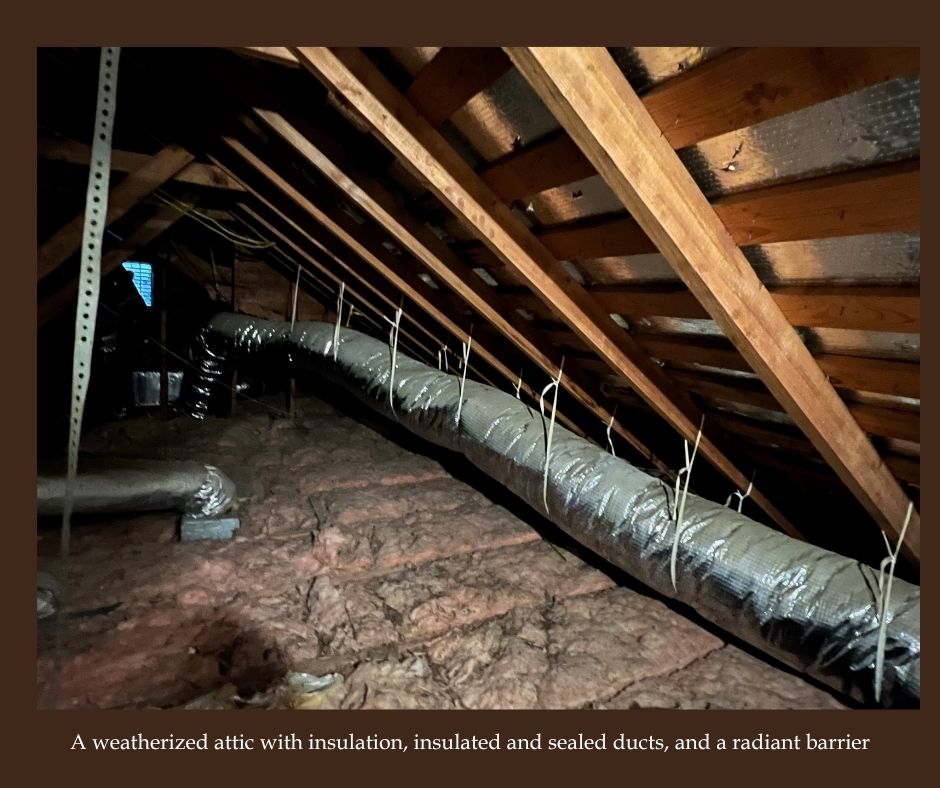
- insulate and seal the air ducts for your HVAC system
- insulate hot water pipes
- install a programmable thermostat and program it to optimize energy savings
- replace old appliances with Energy Star rated ones
- install solar screens on your windows or install solar film on your window glass
- add a radiant barrier in your attic
Expensive but effective things that will save money over the long-term:
- add insulation to your attic, under a room above the garage (or, more expensive, but effective, insulate the walls and floors) Insulation is considered one of the most cost-effective weatherization strategies as it offers one of the best returns on investment, though it does have an upfront cost.
- replace old, single-pane windows with high efficiency windows
- replace your HVAC system with a more efficient one

Do-it Yourself – some of the above things, like changing light bulbs or closing the drapes or even caulking around door and window frames, are easy things you can do yourself and save money. Additionally, the Department of Energy (DOE) has do-it-yourself instructions for some of the weatherization strategies that will walk you through how to do things such as insulate your hot water heater to how to weatherstrip around your double hung windows.
For homeowners and renters with low incomes, the value of weatherization cannot be overstated. Living in spaces that are not adequately temperature and moisture controlled can lead to costly damage and be unhealthy. A weatherized home can make it possible to afford A.C. in the heat of summer and thus minimize the health impacts of high temperatures.
Fortunately, weatherization services for households with low incomes were made available in the Houston area through funding from the U.S. Department of Energy’s Weatherization Assistance Program (WAP). WAP helps about 35,000 people across the US per year. The program has served more than 6.9 million homes and leveraged funding since 1976. Houston Advanced Research Center (HARC) received a WAP grant and partnered with several local organizations including Coalition for Environment, Equity, and Resilience (CEER), BakerRipley, and CenterPoint Energy for a three year pilot program to help households with low incomes weatherize their homes. The partners joined together to provide education about the benefits of weatherizing, discuss available weatherization options, do home energy audits, come up with individualized weatherization plans, and provide financial assistance for home weatherization to families that are economically vulnerable.
CEER helps qualifying low income households receive free home weatherization services that make homes more energy-efficient, lower utility bills, and improve the health and safety of those living in the home – especially during extreme weather. As the community engagement partner, Coalition for Environment, Equity, and Resilience (CEER) engages in outreach to households with low incomes, holding community meetings and office hours to help familiarize community members with the value of weatherization, the weatherization services available, and the process of applying. CEER also helps homeowners and renters go through the application process.
BakerRipley provides home energy audits and free weatherization of homes based on those audits for qualifying low income households. They also provide funds through their Utility Assistance program to help qualifying households pay for their gas and electric bills.
Through its Weatherization Assistance Program: Centerpoint Energy works with community partners to provide free energy audits for qualified residents to assess the energy-saving needs of single-family homes in CenterPoint Energy’s Houston Electric Territory. This energy audit may qualify households for the following free weatherization upgrades; caulking and sealing exterior penetrations, HVAC tune-ups or upgrades, low-flow shower heads, water heater pipe insulation, solar screens (on the south and west-facing windows), LED lighting, ceiling or wall insulation.
During the course of the three year pilot program, CEER engaged 1054 people, 528 of whom applied through the CEER application process. The BakerRipley Weatherization program received 358 applications. 41 applicants have had their weatherization projects completed. 170 more have been approved/are pending. BakerRipley’s Utility Assistance Program has received 417 applications. of which, 262 are approved or pending. CenterPoint’s weatherization program received 409 applications; 115 of those are approved or pending.
Carmen Cavezza, Senior Manager of the Coalition for Environment, Equity, and Resilience (CEER)’s Climate Justice Program points out, “Weatherization is more than making a home energy efficient. For residents in Northeast Houston, it means living in a more dignified home, where they can build wealth and pass it along to their family. Spending less money on energy also means they don’t have to choose between paying the bill or buying more groceries. This program, along with home repairs-weatherization readiness- have made a huge difference for many people.”
Though the pilot is over, CEER continues to work in partnership with CenterPoint Energy to weatherize homes and is currently seeking more funding to make repairs to homes that need weatherization so that they will be weatherization ready.
BakerRipley is also still accepting applications and doing audits and weatherization for qualifying households. On Monday May 11th, they will open their Utility Assistance Program portal for another round of applications for that program.
Also available in the Houston area are weatherization workshops with hands-on training and free weatherization toolkits for participants.. Thanks to a generous grant from the CenterPoint Energy Foundation, Citizens’ Environmental Coalition in partnership with the City of Houston Green Building Resource Center has been providing a series of weatherization workshops, some virtual, some in person, for the Greater Houston area. The next workshop, hosted in partnership with Sunnyside Community Redevelopment Organization (SCRO), Coalition for Environment, Equity & Resilience (CEER), and Ready Harris, will be a hands-on event that is designed specifically for seniors on May 12th from 10 -12 at the Sunnyside Health and Multi-Service Center.
Resources and references:
Baker Ripley’s Weatherization Assistance Program:
https://bakerripley.org/
CEER’s weatherization assistance program: https://ceerhouston.org/
CenterPoint Weatherization Assistance Program:
“Do-It-Yourself Energy Savers Projects from the US Department of Energy” https://www.energy.gov/
Houston Advanced Research Center (HARC) Weatherization FAQ