Meet Gleeson Ryan: Bringing Stakeholders Together and Creating Art to Move the Needle on Environmental and Social Progress
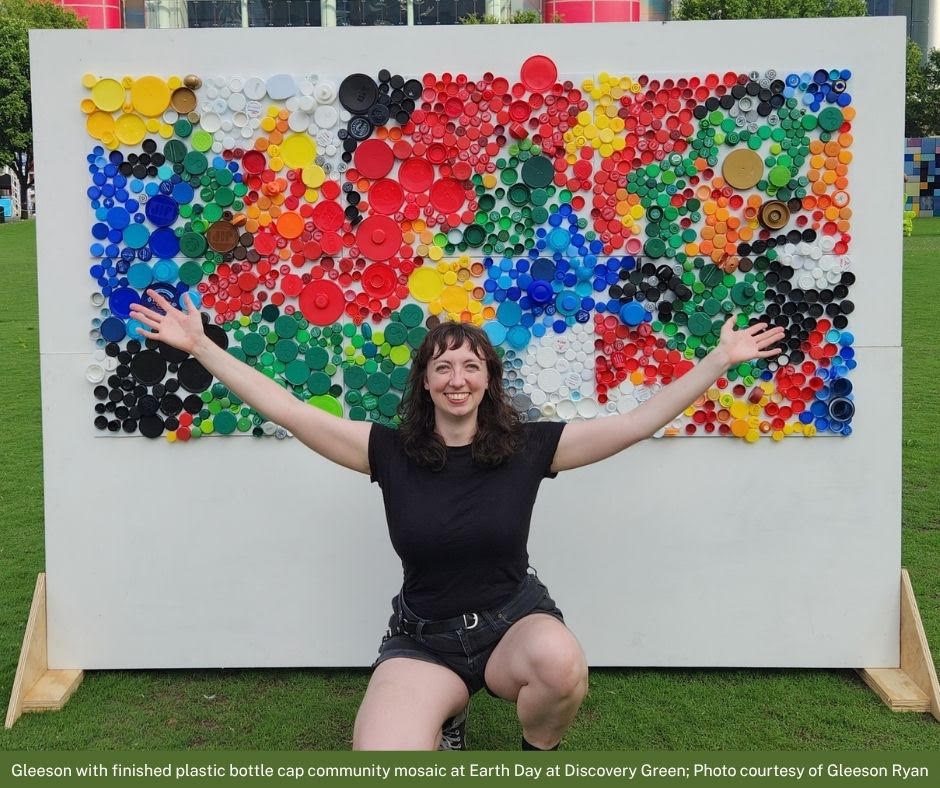
Gleeson Ryan sees her job as Senior Manager for Future 500 and her art practice as two ways of addressing the social and environmental issues we face.
At Future 500, a non-profit, whose goal Gleeson explains “is to build common ground between corporations and their stakeholders — activists, philanthropists, and environmental NGOs — to build bridges in order to find solutions to environmental and social issues,” Gleeson is part of a team of five, so it is “all hands on deck all the time.”
Gleeson explains that in order to achieve their goals “we help these stakeholders, NGOs, and companies find common ground on issues they are facing so they can develop strategies to address them. We also hold convenings — called corporate working groups — where we bring everyone together in person. While people don’t always agree with each other, we can help create some shared space where they can make some progress.”
“Though I’ve only been with Future 500 for 3 years, we’ve existed for over 30 years — we have a deep network of folks we know well and know how to work with. It is really rewarding to get Exxon and Greenpeace, for example, in the same room to work on something.”
In addition to bringing people together to make progress on their differences through conversation and mediation, Gleeson also uses art to inspire people to take action to make change on environmental and social issues.
When I ask her how she manages to juggle the time demands of both of these undertakings, she says, “ What’s fun for me is that my art practice and my job are often tackling the same issues, especially environmental and materials issues. I often work with repurposed materials — both to message the importance of conservation of materials and reducing production through reuse, but also because I am interested in finding the stories of these materials. I do a lot of work in textiles. If you take a piece of clothing apart and reconfigure it – the story of whoever wore that beforehand is now blended with its new purpose — it brings more layers into the piece.”
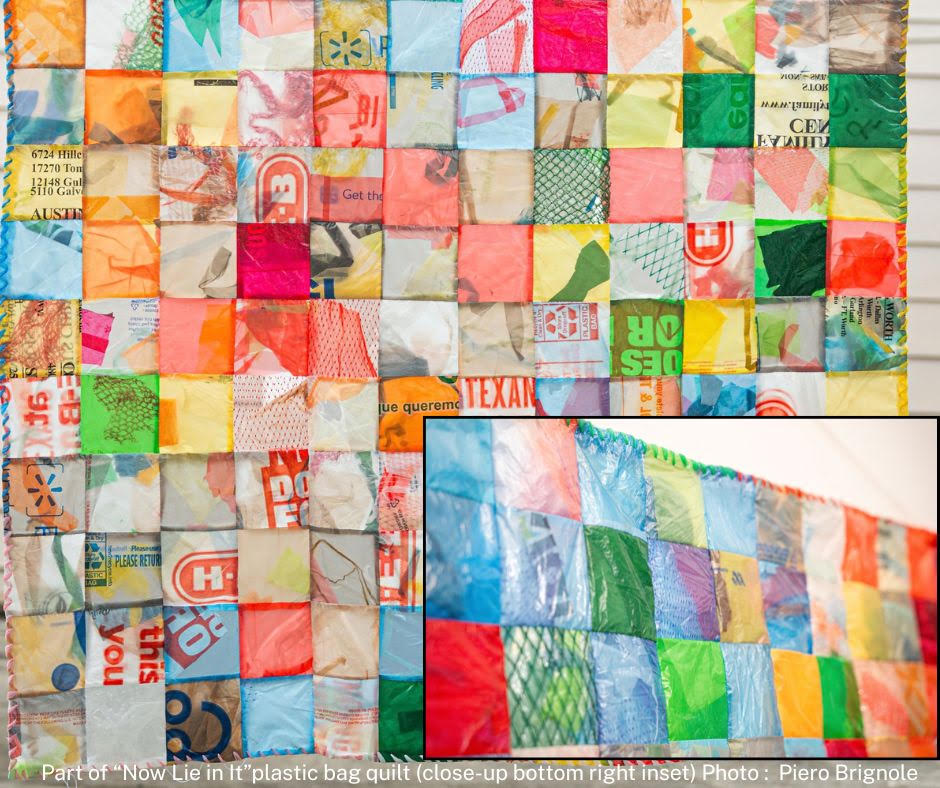
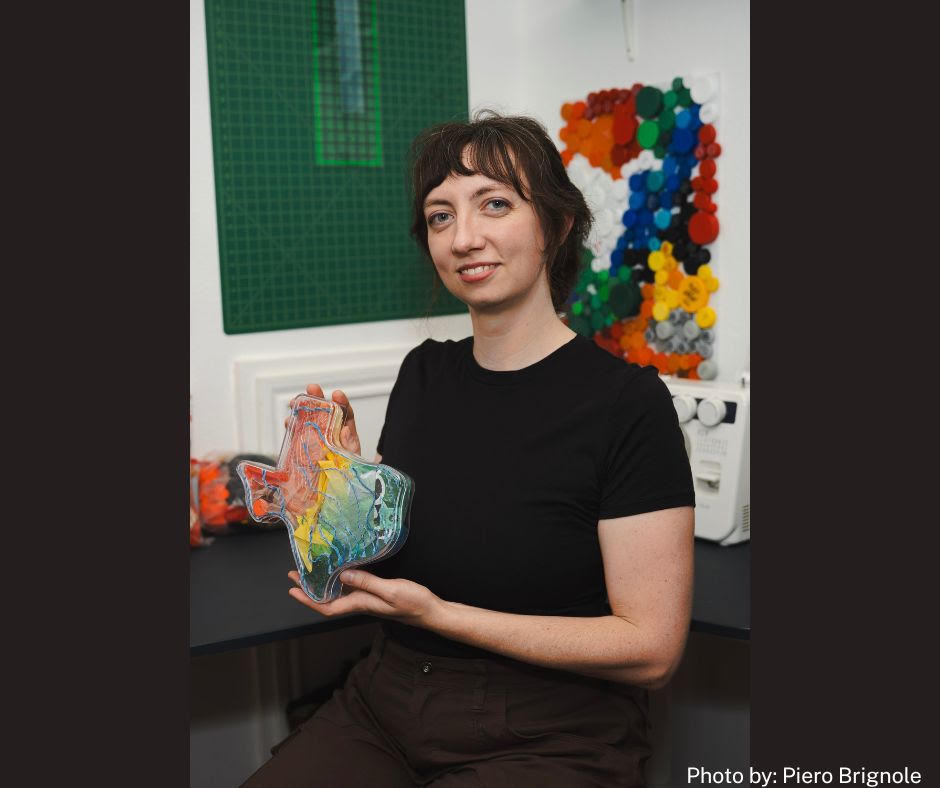
One message she hopes people get when they see her work is that a material we typically see as trash isn’t necessarily waste. She gives the example of a quilt she made from plastic bags titled “Now Lie In It.” “I want to have people look at a plastic bag and not just see trash, but see something with value. I am trying to shape how people look at what we’ve been trained to see as waste — to see it as something with possibility, something worth stewarding.”
She pushes back a bit on the word “artist.” “I’ve always been someone who makes things; in high school, I worked in a wood shop, and the term ‘maker’ felt more accurate. It’s only in the past couple of years that I have made the connection to the word ‘artist’. While it can help people better understand what you do, that word comes with a certain set of expectations and ideas about how you do things. I am still learning how to speak about what I do.”
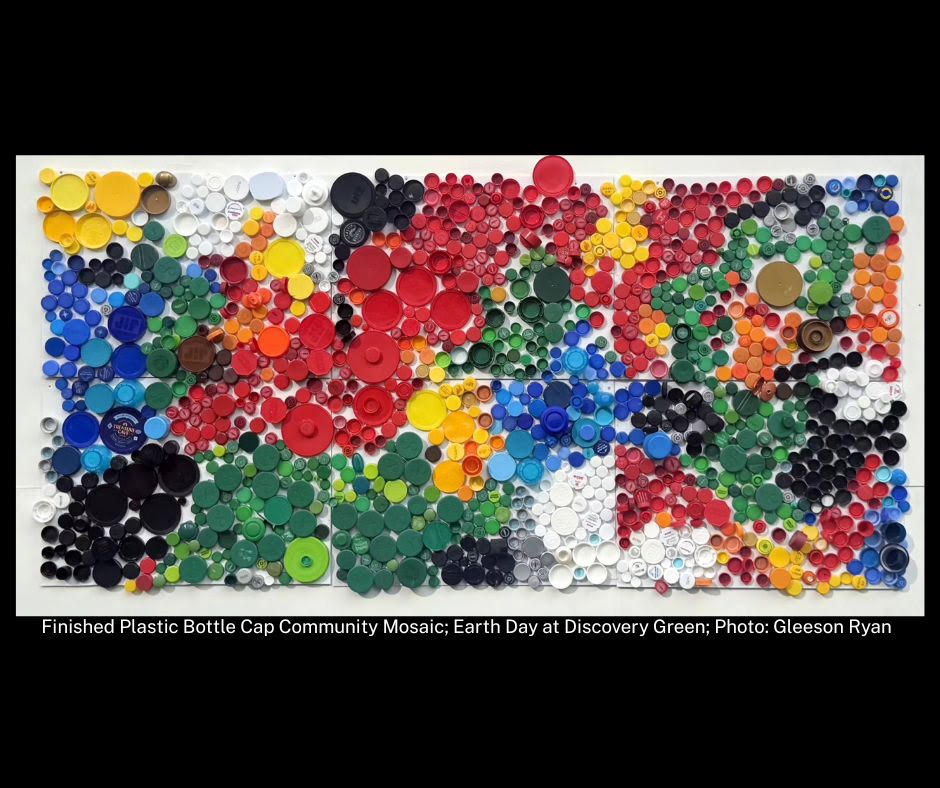
Lately, she has been particularly interested in doing collective community artworks, “ I’ve been enjoying the community pieces I’ve done — it is really unique to see how the community can activate to create something.” One of these projects was a community mosaic she facilitated for Earth Day at Discovery Green. She will be doing another public project at CEC’s Greater Houston Environmental Summit on October 23 -24.
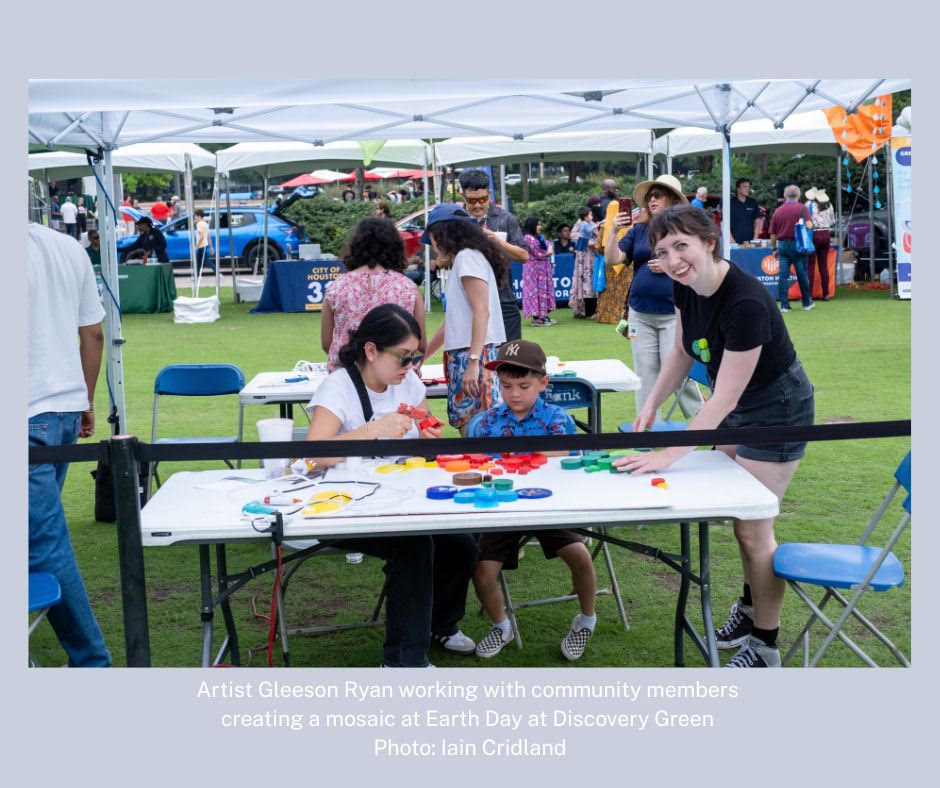
At Earth Day Houston, Gleeson offered a menu of sustainable actions or “Eco-mitments” that individuals could make, grouped into categories and ranging from things that involved minimal commitment to more time intensive activities. There was something that everyone could do on this list. Individuals chose actions they were going to commit to do, wrote them on a commitment sheet and then, based on the categories they chose their commitment from, got to choose colored plastic bottle caps, salvaged over months, to glue on to a large-scale bottle cap mosaic. This project was a many-layered example of art that promoted sustainability — the product was made from things that are usually too small to recycle — thus reusing something that otherwise would end up in a landfill. The project invited individuals to participate in the sustainability of their community by selecting and committing to an action they would take and by having them contribute to a larger work of art. Additionally, Gleeson followed up with all the participants via email to see how they were doing with their commitments in the weeks after the Earth Day event, driving longer-term action and gathering data on the results.
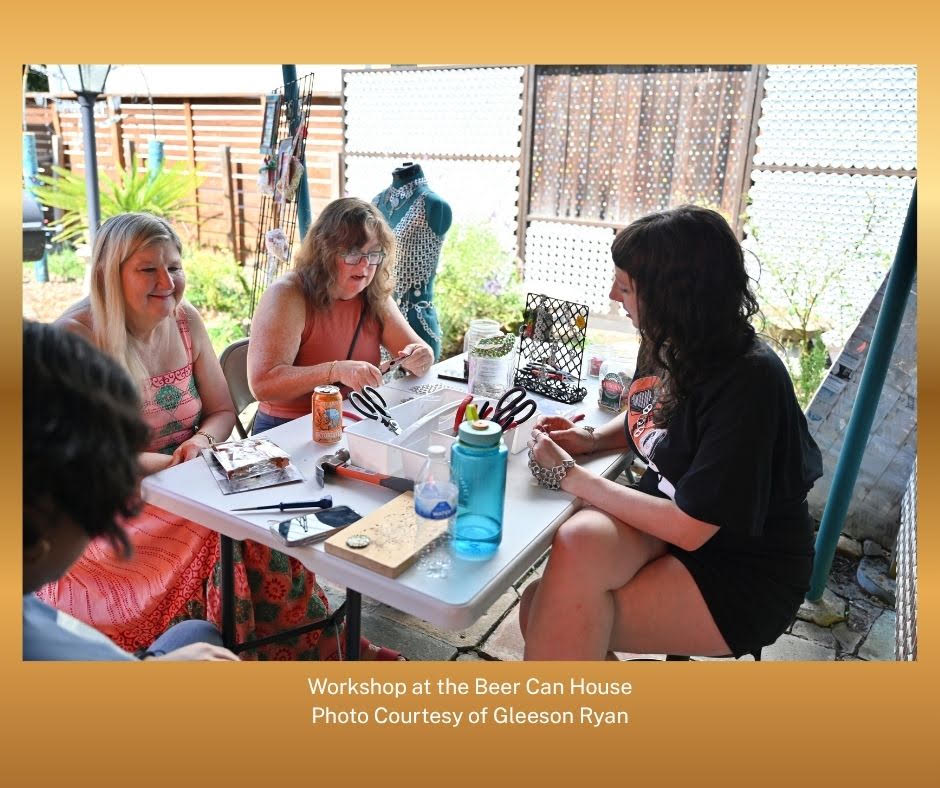
Gleeson also teaches workshops. “I do a lot of work with the Orange Show, which can be thought of as the core of repurposed art in Houston. I host a monthly workshop at their Beer Can House where people can help restore the house itself and also make jewelry out of aluminum can tabs to take home — inspired by the house’s creator, John Milkovisch. I’ve also taught other kinds of upcycled art workshops at the CAMH and U of H, and I’m always open to more.”
Gleeson first stumbled across the Beer Can House right after she arrived in Houston and started exploring her new home. She immediately fell in love. “It’s my shrine — my happy place.”
Gleeson ended up in Houston after having lived in six different states. “I’ve been in Houston now for five years. I am drawn to it because it is fascinating — a hub for global energy production, but also an area deeply affected by climate change. There is immense potential to make progress here. The city is also rapidly growing and I see it on the forefront of the culture across the US. If we can solve some of these challenges here, then that will have a huge impact everywhere else, both in the US and globally.”
Gleeson sees her work building bridges between industry and stakeholders and her work as an artist as connected: When I ask how her degrees in business and international studies and her work with industry inform her art, she says: “They have to be connected, right? Business is about how you get things done and art is about why you get things done — two different ways of making change in the world. If you can enable companies to make even marginal improvements, that has huge ripple effects down the supply chain. If you can influence an audience to see materials not as trash but as things of value, that can change how they behave, which also has a ripple effect. In both things I do, I’m working towards the same goal: it’s important to have different ways to make these themes resonate with people.”
Though she did (unsuccessfully) run for the Green Party in 7th grade, she did not truly focus on sustainability until college. Before that, she focused on public policy, language and international studies. It was a college internship at the Embassy of Ecuador in Washington D.C. that was a turning point.
While working at the embassy, she learned about the damage that an oil spill had caused to the Ecuadorian rainforest and indigenous communities and she began to understand the criticality of building responsible energy systems. “That’s when I got interested in energy and began to explore the energy industry more deeply. Energy is embedded throughout our society – it’s connected to the wellbeing of everyone on earth, so I wanted to understand how to make it safer and more sustainable.”
“That’s why I originally applied for a job at an oil company — I wanted to see how energy systems are built, how decisions are made, and how we can improve them over time.” So first she interned with and then worked for Chevron.
“While with Chevron, I had six different jobs in six years — everything from stakeholder engagement, to policy, to community affairs — how you bridge the gap between community and the company and create meaningful relationships.
“When I lived in Salt Lake City, I worked in the refinery.” When I ask her what she learned while working with fenceline communities next to the refinery, she explained “It was a good reminder that communities are not monolithic. Many folks are happy for industry to be there — it drives economic and family wellbeing. There are always environmental concerns and folks opposed to industry, but it’s important not to make assumptions in either direction. You need to listen to people on the ground as you try to make things safer for both the workers in the refinery and the surrounding community.”
“The job in Salt Lake was not only about preparing emergency response protocols for the community in case of an incident— it was about building pathways for the community to be heard and to make sure that communication is consistent and constructive.”
When I ask Gleeson what she does in her free time, she shares “I’ve been taking a lot of online classes — I’m currently taking one about plastics policy and am about to start one about the intersection of art and environmental justice. I also recently attended the Salvage Art Summit online with “artivists” from all over the world — it was really inspiring to see all the people working in this area, transforming what is generally regarded as waste as, instead, something that can be repurposed and used, and also make change.”
I asked her what her thoughts were about the relative impacts of individual action and broader systems change. She responded, “We need individual action, and we need collective action. We need regulation, and we need corporate strategies. We need all of these pathways to make progress together if we want to be successful.”
When I ask her about what participants should expect from her community art project coming up on October 23rd and 24th at the Greater Houston Environmental Summit, she explains “Over the course of the two day summit, I’ll be creating “Layers of Resilience” — a large-scale, live collage installation made from elements contributed by those attending. I will have people create or select images in response to three different prompts about disaster resilience in Houston. I’ll have dozens of National Geographic magazines that people can choose images from, or they can draw pictures or write notes. If people want to bring photos or newspaper clippings of disasters they’ve experienced, that’s also welcome. The final collage, composed of everyone’s contributions, will represent this collective experience of hope and resilience.
“The project is meant to both reflect on the past and inspire the future, but the core goal is to look forward to see how we can build better systems, strengthen communities, and care for one another in the face of what’s to come.”
A worthy goal, in art and life.