Honeybees
by Susie Hairston
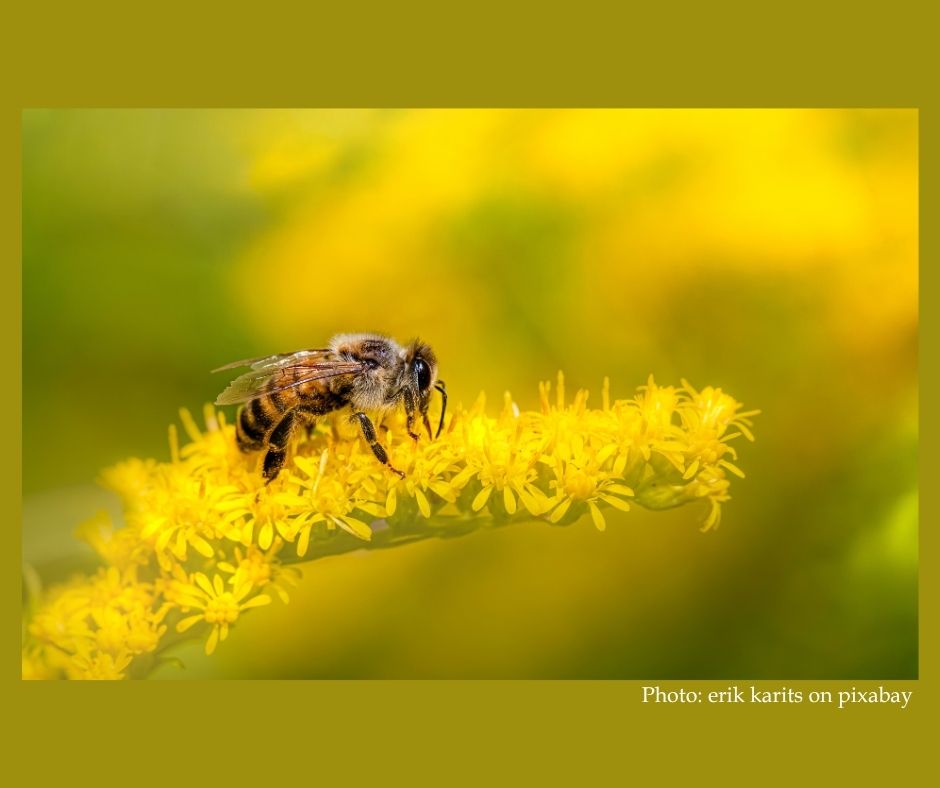
Many Americans do not realize that honeybees are not native to the U.S. They were brought over by colonists in the 1600s. The first bees arrived in Virginia in 1622, and it took 231 years for them to make it all the way to California. The bees were originally brought to pollinate all the non-native food crops that Europeans also brought with them.
Today, many foods that we love and eat in the US rely on honeybees for pollination. Almonds could not be grown if it weren’t for honeybees. Other foods such as cherries, blueberries, apples, avocados, watermelon, and cucumbers, rely heavily on honeybees for pollination, although other pollinators play a role in pollinating those crops as well.
Honeybees also play an important role in pollinating crops such as alfalfa that provide feed for cattle, thus indirectly being very important to beef production.
In addition to pollinating food crops and flowers, honeybees also make honey.
Honeybees live in groups called colonies. Every bee in the colony has a designated function. The queen, who is the largest bee, runs the hive, and her whole job is to produce more bees. She is able to control whether she is producing a male or female egg.
Male eggs turn into drones, large bees that have the sole purpose of mating with the queen so she can produce more offspring. The drones sit around eating until it is time to mate. Mating occurs in midair and males die when their abdomen rips open from the force of injecting their sperm into the queen. More drones are made than are chosen to mate. Those who do not mate with the queen are thrown out of the hive or outright killed when winter comes.
Worker bees are all female. They perform many functions in the colony depending on their age. When they are young, they keep the hive clean, then they move on to taking care of the larval bees in the nursery, then to taking care of the queen, then to storing nectar, then to guarding the hive, then to foraging for pollen. And though they have tiny brains, bees can communicate. The worker bees tell each other the location and quality of pollen sources by doing a waggle dance.
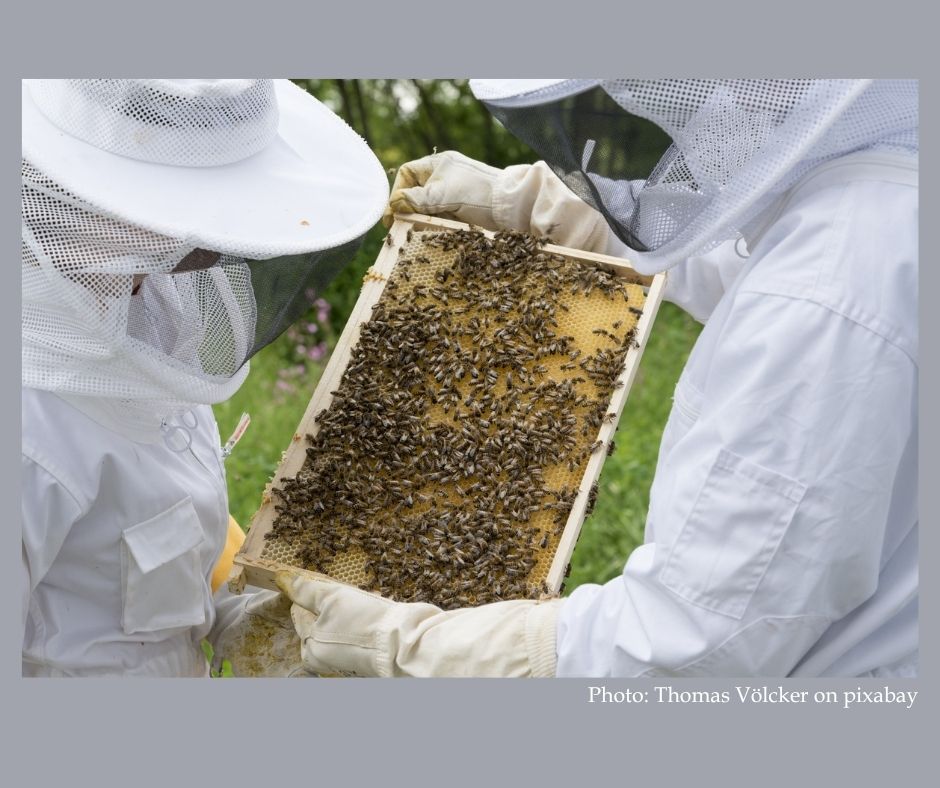
When many of us think of honeybees, we think of the ones we have seen buzzing around one of the flowering plants in our garden or we imagine a feral colony in the hollow of an old oak tree overhanging an apple orchard zooming around pollinating the crops or we think of a couple of boxes of bees managed by a local beekeeper.
But large scale farming involves mobile beekeepers taking their bees on the road in semi trucks – going from pollinating a crop in South Carolina to a crop in California. In the United States, paid pollination services and crop yield boosts exceed $15 billion per year. “In 2026, American beekeepers collected approximately $400 million in pollination rental fees. The crops their bees pollinated were worth $18.9 billion.”
Honeybees, unlike wild native bees are considered to be managed livestock, like cattle, and though there are wild colonies of honey bees who have split off from their commercially wrangled fellows, those are also considered managed livestock, though they are not being managed.
Honeybees differ from most native bees in that they live in colonies where each bee has a defined role to support the queen and the overall health of the hive. Though there are some exceptions, such as bumble bees, most native bees are solitary — living on their own, not in group housing.
Honeybees are not considered to be endangered, but there are many threats to their survival, including a changing climate, habitat loss, pesticide use, various parasites. and nutritionally deficient plants caused by monocultures and chemical fertilizer use. Kept bees, particularly, the mobile ones, experience a lot of stress. In 2007 mobile beekeepers started reporting cases of Colony Collapse Disorder (CCD) where the majority of the worker bees disappear from the hive, leaving a few nurse worker bees, larval bees, food, and the queen behind. The hives cannot survive without a large number of workers.
You might worry that we would not survive without honeybees because they pollinate so many of the foods we eat. But we would. Some of our staple crops like wheat and rice do not rely on honeybees. Our food would be more expensive and a lot less diverse, a lot less nutritious, and a lot less delicious — gone would be apples, almonds, and berries. Most concerning would be the collapse of ecosystems where bee pollination was a critical component. A cascade of destruction would occur.
Scientists in Japan have developed a robotic bee prototype that can pollinate plants. My question is: why aren’t we saving the perfectly designed “bee”ings that we already have, rather than focusing on replacing them with some piece of technology that will in no way be as good as the original. What is the matter with us that we continue to destroy the beauty and function that has developed over millions of years of evolution in the hopes that we will make some dime store junk version that will make up for it? It won’t. Save the bees — honey bees, native bees, all “bee”ings.
Actions you can take to protect honey bees and native bees:
- Stop using pesticides
- Use compost in your garden to ensure you are growing nutritious plants to support our pollinators
- Plant a pollinator garden with many diverse native plants
- Buy local honey to support local beekeepers
- Don’t buy plants treated with neonicotinoids
- Support local organizations that promote natives and conservation of land such as the Native Plant Society of Texas Houston chapter, Bayou Land Conservancy, Friends of Woodland Park, Friends of Columbia Tap, Houston Arboretum and Nature Center, Exploration Green Conservancy, Buffalo Bayou Partnership, Artist Boat, Edith L. Moore Nature Sanctuary, Environment Texas, Houston Botanic Garden, Blackwood Educational Land Institute, Mercer Botanic Garden, Houston Parks Board, Bayou Preservation Association, Discovery Green Conservancy, White Oak Bayou Association, Urban Harvest, Galveston Bay Foundation, Galveston Island Nature Tourism, Coastal Prairie Conservancy
P.S. Great bee books to read:
- The Bees: A Novel by Laline Paull. One of my favorite dystopian novels — the heroine in this book is a worker bee who colors outside the lines in the hive. What is great about it is that the author uses the actual facts about bees and how they operate to create this dystopian world.
- The Beekeeper’s Lament: How One Man and Half a Billion Honey Bees Help Feed America is the true and fascinating story of one mobile beekeeper and the threats to America’s honeybee population.
- The History of Bees by Maja Lunde follows 3 generations of beekeepers, the final one
having to hand-pollinate crops because the bees are extinct.
Resources and References:
https://apiaryproject.com/blog/pollination-economics-what-bees-worth-american-agriculture
https://www.britannica.com/science/colony-collapse-disorder
https://www.britannica.com/story/what-would-happen-if-all-the-bees-died
https://www.cnn.com/2017/03/09/world/artificial-pollinator-japan
https://www.ers.usda.gov/data-products/charts-of-note/61623
https://www.keepingbackyardbees.com/the-dances-of-the-bees/
https://www.losangelescountybeekeepers.com/history-of-honey-bees-in-ameri
https://www.nationalgeographic.com/animals/article/honey-bee-job-queen-hive-animals
https://www.perfectbee.com/learn-about-bees/the-science-of-bees/how-honeybees-reproduce