First Texas Cohousing Community opens in Houston’s East End intent on building community and living sustainably
by Susie Hairston
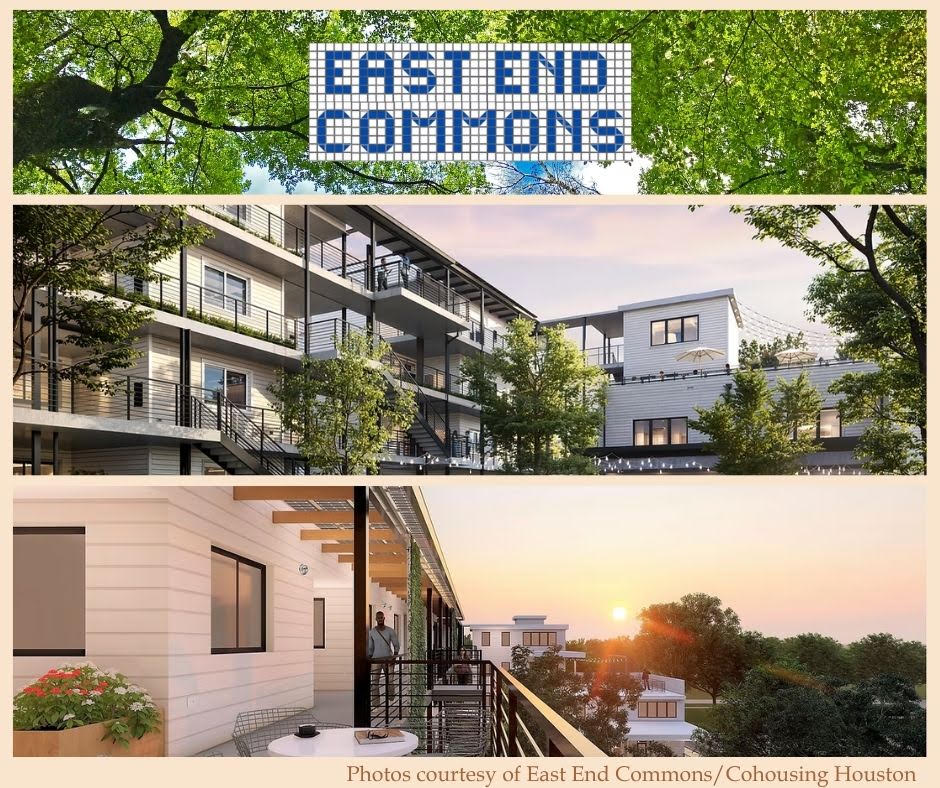
It’s been a long time coming, but July 31st was the grand opening of the very first co-housing project in the state of Texas, East End Commons, and it is right here in Houston’s East End. In addition to focusing on connection and inclusiveness, this cohousing community values sustainability, and has incorporated that value into its design.
The modern cohousing movement started in Denmark in the late 1960s. It originated as a way for families with young children to share childcare and chores — to create a village in which to raise children. The movement has since expanded to include multi-generational communities and communities formed primarily of seniors seeking to build community and stave off loneliness.
Though cohousing communities take different forms, they all share a few commonalities:
- they are intentional communities designed, from the location of the parking through the distribution of common space, to encourage and facilitate community and interaction
- the communities have modest self-contained homes for each family/individual and large shared community spaces for gathering such as a kitchen and dining room, guest rooms for visitors, and gardens and greenspace. The parking is typically on the exterior of the community so that the community itself is walkable and residents traverse through community spaces and interact when they are coming and going.
- these communities are usually managed by the residents, typically by concensus.
If the design is sounding to you like many modern apartment complexes, it is similar. The difference is that communal spaces in apartment buildings are amenities that individuals can use when needed, but the communal spaces in a cohousing project are the raison d’être of the place, where the residents come together to form community through shared meals, group community improvement projects, regular governance and committee meetings, and informal gatherings.
East End Commons has 33 units ranging from 1 bed/1 bath residences to 4bed /2.5 bath townhomes. This multigenerational cohousing community has residents that range in age from 3 to 80+.
The design features that help create community at East End Commons start with its location in a bustling area in the East End that is walkable to the metro green line, bookstores, coffee shops, an urban farm and farm stand (Finca Tres Robles), Eastwood Park, and a charter elementary school.
The parking is on the exterior of the community so people have to walk through the shared spaces to get to their homes from their cars, enabling them to run into and interact with other community members in a way that would not happen if parking were adjacent to each unit.
All of the homes open onto a shared green space and garden area. There is a large common house that includes a kitchen and dining area designed for large gatherings; a guest room that can be reserved by any resident for visiting guests, helping to connect visitors to the larger community; a mailroom, where everyone runs into each other while getting their mail; a co-working room and meeting room; a laundry room; and a large second floor patio area for outside gatherings.
Each of the homes has its own private patio space that opens onto the large green space, but these patio spaces are open rather than fenced off, allowing engagement, and, on some of the floors, individual patios connect to larger community spaces with cozy seating where people can hang out in larger groups.
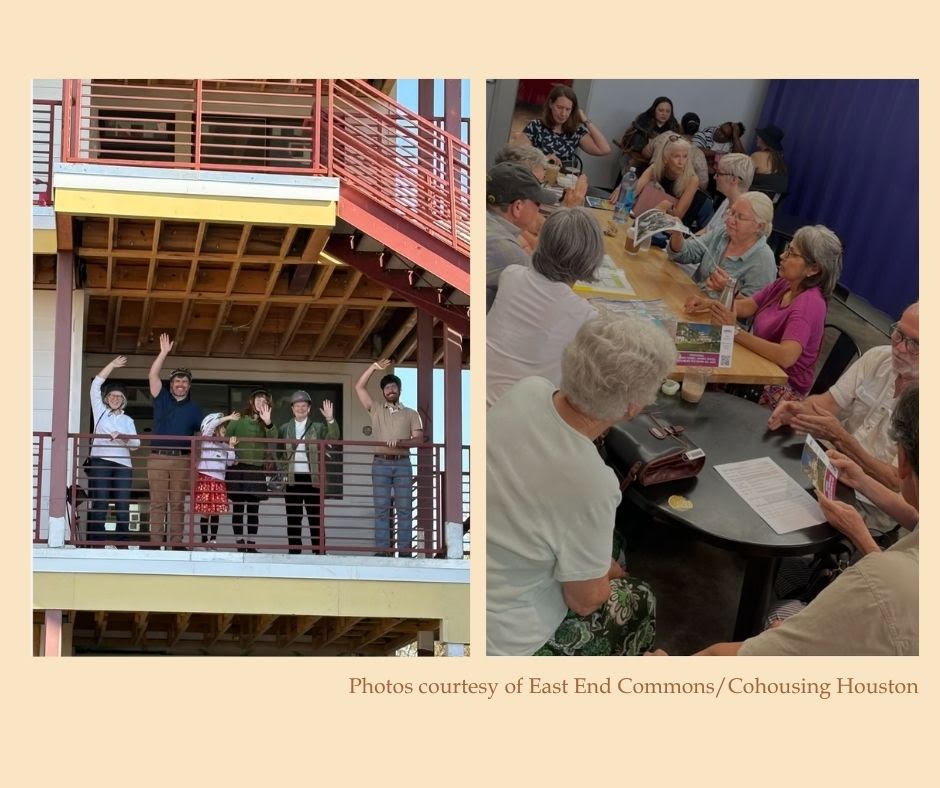
In addition to the design features that help build community, activities and the joint management of the property encourage bonding.
For the East End Common residents, this process of bonding began long before the property was designed or built; it began in 2017 when a group came together with the intention of building a cohousing residence. Residents who had committed to purchasing their units worked with the architects to design the building and grounds for maximal interaction. The residents have now known each other for years. The team building entailed in working to plan the project and laboring side by side to put in landscaping, etc has made them close. Over the years, they have had dinners, game nights, fireworks viewing, a sing-along, pumpkin carving, a tiki bar, movie outings, and concerts.
Like other cohousing projects, the residents at East End Commons manage the property. Each resident is required to be on one committee such as gardening, finance and legal, common house, infrastructure, etc. This has several advantages. In addition to saving everyone money in property management fees, it is central to building community. As East End Commons resident Steve Stelzer pointed out, managing the property this way “saves money and makes you more invested in the place and each other.”
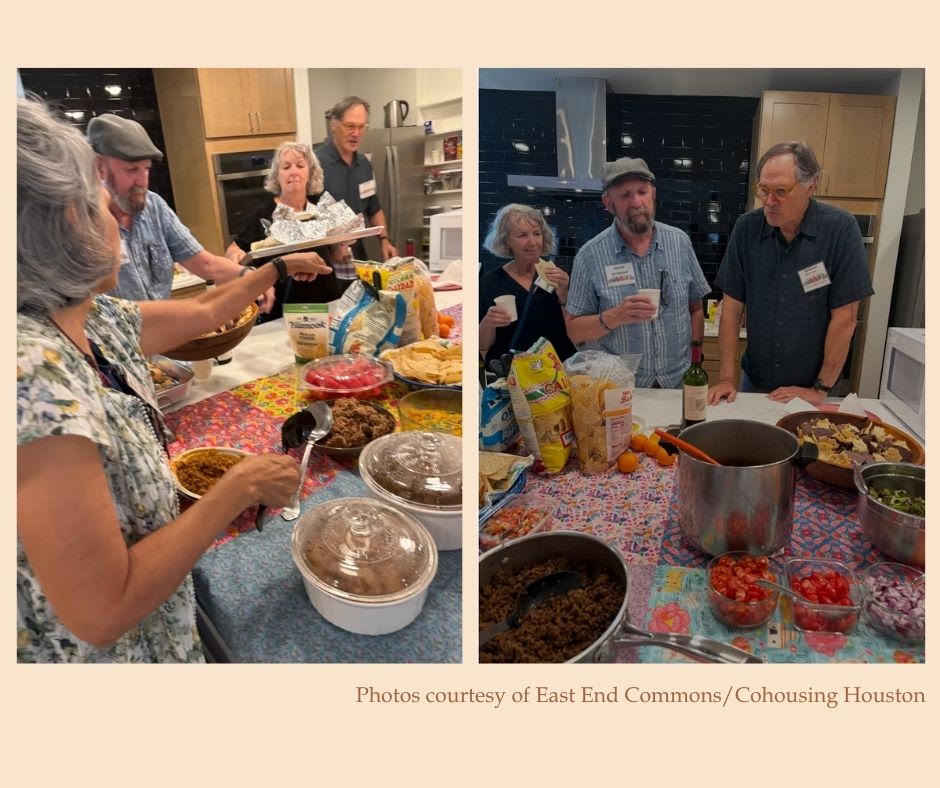
Once everyone is moved into East End Commons, the residents plan on having at least one community meal per week in the Common house. People on various committees will continue to meet with one another to address issues in their purview and to do things like garden, figure out why the back-up generator isn’t working, etc . . . They will continue to have community work days and spontaneously organized special events.
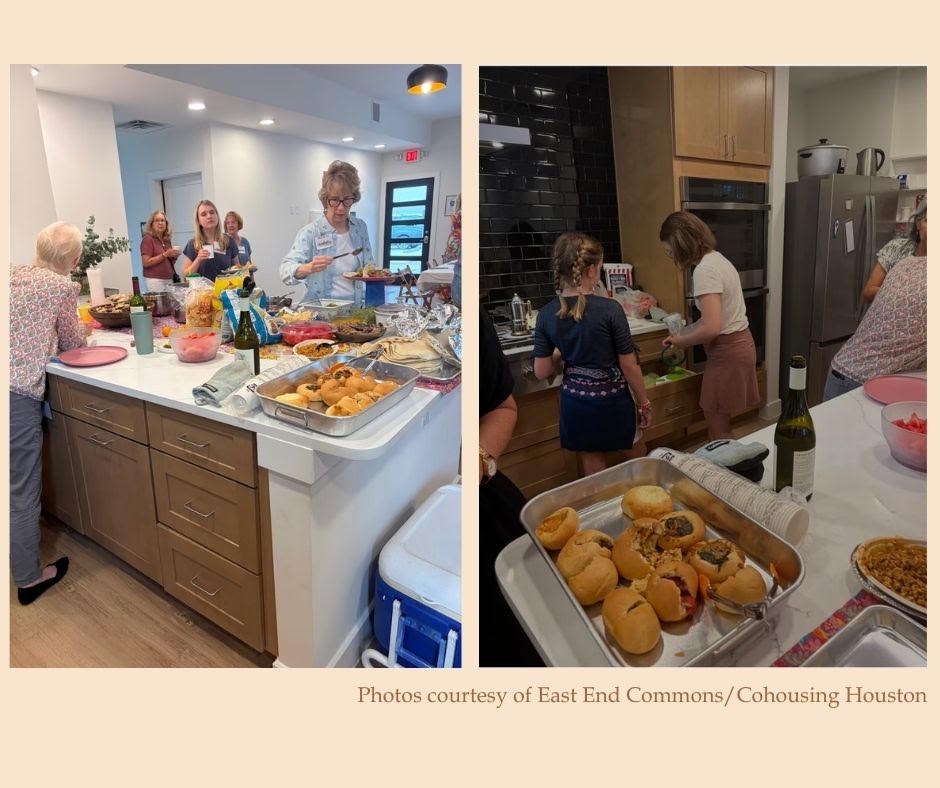
Cohousing is essentially replicating the neighborhood experience that many boomers grew up with, but which, with the exception of a few pockets here and there, has been lost to our busy lives and our fragmented culture. CEC board member Steve Stelzer and his wife Kathleen English have been members of the cohousing group developing East End Commons from its early days. Steve explained that they got involved because “the appealing thing is the interactions – we really like the idea of interacting with our neighbors, and the neighborhood we previously lived in had declined for us in neighborly interactions. The peak of neighbor engagement was when the kids were young and there were a bunch of kids and gang parenting — we missed that.”
East End Commons resident Kelli Soika has lived in intentional communities for the majority of her adult life, starting when her youngest daughter, who is now in high school, was three, in a cohousing community in Fort Collins, Colorado. She feels that one of the huge benefits of being in a cohousing community is the multigenerational aspect of it, that you get to be friends with people who are twenty years your senior or 20 years your junior, unlike in other living situations where you find yourself only interacting with people in your own stage of life. She told me that when she was younger, “It was really great to live in cohousing because I had really small kids and liked being around people with different life experiences — people with grown children and people younger than me.” And now, as her children are growing up and moving off to college she finds that, “suddenly I’m in a role where I can dole out advice, but also can receive wisdom from people who are older than me.” She finds it valuable as she is transitioning from one phase of life to another to be in a community with people who have already made that transition. And the community helps with that transition in other ways. She talks of others she knows with older kids “I see my peers, when their kids leave, experiencing a feeling of ‘I’m not needed as much. What am I going to do?’ Cohhousing gives you a lot of opportunities to be purposeful,” helping you through life’s transitions.
Sustainability:
Cohousing projects are inherently sustainable in the sense that they usually have a smaller footprint per person than a home in a typical neighborhood, they share resources, encourage walkability, etc.
But in addition to the inherent sustainability of decreasing the footprint per family/individual, East End Commons has incorporated sustainability as one of the values of their community. Sustainability began with the choice of the location of the building — set in the East End ,within walking distance to Eastwood Park, coffee shops, restaurants, kids activities, an urban farm and farm stand, a Green Line light rail stop, and more.
Steve Stelzer explained that in terms of sustainability features, “The big ticket item was the geothermal system — all the units have an HVAC. The difference is that we went with a ground source heat pump rather than the standard air source heat pump. All of the individual units are connected to water pipes that go to a series of wells – we have a well field — and the waste heat from the AC goes into the wells. With an air source heat pump, you have a compressor outside and a fan is blowing waste heat outside, where it is wasted and contributes to making an already hot outdoors hotter in the summer.
East End Commons’s heat pump system was designed so that the pipes with the heated water headed for the well field stop first at a central water heater for the whole complex so that it provides preheated water for showers, dishwashing and laundry to everyone’s home, saving money and energy on household water heating.
Steve pointed out, “Part of the magic of the geothermal system is that not only is it sustainable, but there is a gigantic benefit to not having to have 33 compressors either taking up people’s porches and making noise or up on the roof where they would be harder to maintain. Kelli Soika added that the geothermal system also saves them all money. She says, “Our electric bill is absurdly low.”
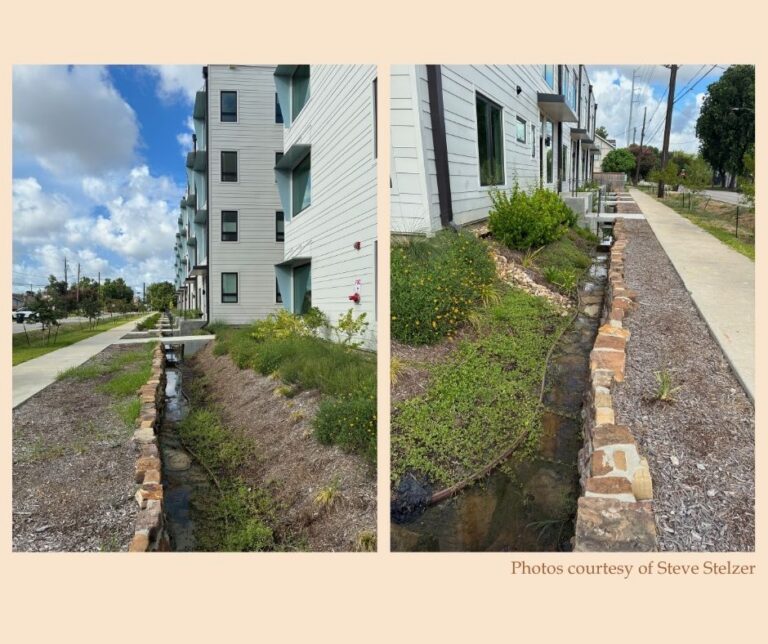
Other sustainability features include: a bioswale to help prevent flooding that runs along the street facing side of the building that is planted with native plants that provide habitat and food for birds and insects; water detention under the community garden; on site composting that allows them to make their own nutritious soil amendment for their garden, divert waste from the landfill, and save money on landfill tipping fees.There are EV chargers in every garage and carport on the property’s periphery.
All of the appliances in the units and common house are Energy Star. All the lighting is LED.
The building, garages and carports are solar ready though they do not currently have solar panels.
The residents will be recycling by collecting materials and making runs to drop things off at the nearest city of Houston Neighborhood Depository. Currently, as everyone moves in, the main recyclable they have is a lot of cardboard boxes. Kelli Soika explained that they are using one of the garages to put the boxes of someone who has just unpacked, which then get repeatedly reused by others as they pack their current residences to move into East End Commons.
As Kelli explained, “we have a share-don’t-buy culture.”
90% of the Common House has been furnished with things that incoming residents no longer need/have room for in their new smaller living spaces.
Though they do not currently have a shared tool storage area, they do have an email specifically for requesting to borrow tools so that not everyone has to own a saw, for example.
Kelli pointed out what she thinks is the most important aspect of East End Common’s sustainability initiatives. “Sustainability is a snapshot.” What is cutting edge now and what works with the current climate may not work 10 years down the road. It is the ongoing commitment to sustainability that is key” “One of the things that doesn’t get talked about is their intentionally to support these principals, and that, in itself, makes sustainability work rather than devolving into apathy or infighting.”
If you are interested in learning more about cohousing and East End Commons, Steve Stelzer is giving a talk about living in cohousing at the Houston Sierra Club’s monthly meeting this Thursday, August 13th 7:00 – 8:30 p.m. at United Way of Greater Houston. Several units are still available to purchase or rent at East End Commons. If you are interested in setting up a tour, check out their website and contact: info@EastEndCommons.org