A Bag Full of Change: Dr. Anna Weiss and Green Galveston’s Breakthrough in Eco-Education
By Leah Cast
When Dr. Anna Weiss set out to demystify bioswales, she didn’t publish a paper – she packed the solution into a bag.
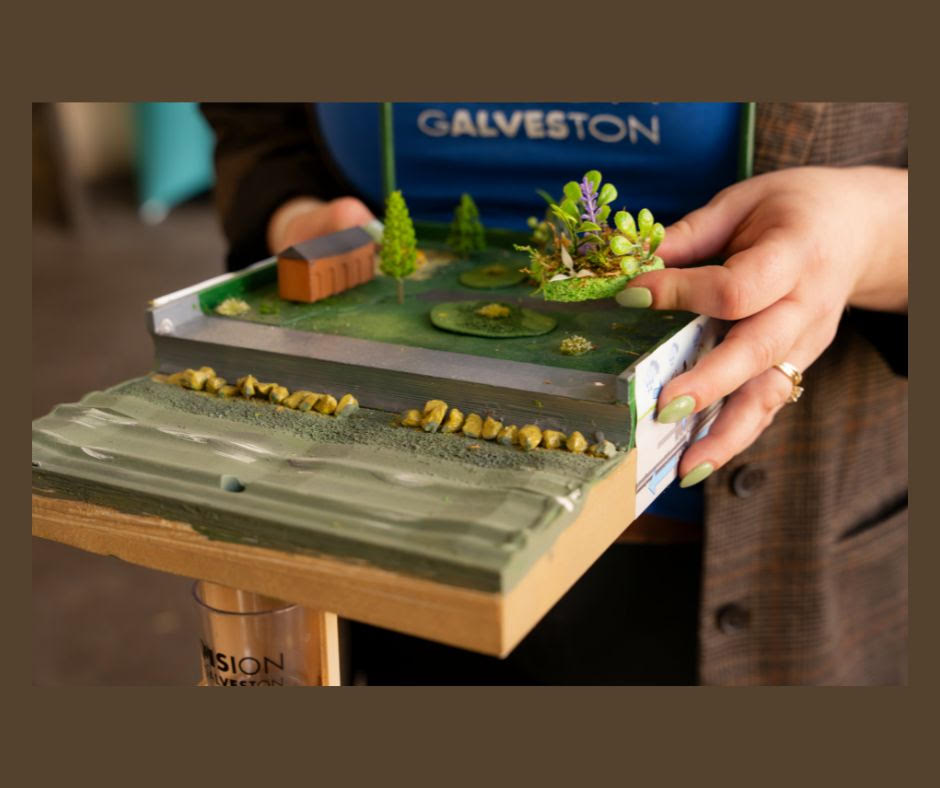
The academic scientist and former professor is the inventor of Bioswale in a Bag, a portable, visually engaging teaching tool that’s transforming how environmental educators explain nature-based solutions. Developed in collaboration with Green Galveston, the hands-on model simulates a suburban landscape (complete with trees, houses, streets, and cars) to show how bioswales work.
In a world of rising floods and polluted runoff, bioswales offer a simple, natural way to protect our communities. These vegetated channels help manage stormwater by filtering pollutants and allowing water to soak into the ground. In urban areas, they reduce flooding, improve water quality, and recharge groundwater – yet many people have never heard of them.
“Most educational models are bulky, fragile, and costly,” said Weiss, director of Green Galveston. “I wanted something educators could toss in the backseat and take anywhere – into classrooms, community centers, and parks.”

The idea took root during Green Galveston’s redevelopment planning for Jones Park, a flood-prone area where bioswales have been designed into the park’s layout plans as a stormwater mitigation strategy. Weiss saw an opportunity to make the concept tangible. The result? A lightweight, durable model now used across Texas and beyond.
Organizations across the country have adopted the tool, including Texas Parks & Wildlife, Texas A&M Forest Service, Texas Sea Grant (Galveston and Corpus), Houston-Galveston Area Council, Custom Coastal Outreach, Moody Gardens, a stream conservancy in New York and beyond.
Texas Sea Grant – a collaboration of NOAA, the State of Texas, and universities statewide – uses Bioswale in a Bag at conferences and workshops to teach how nature-based solutions strengthen flood preparedness and protect water quality across the Texas coast.
“I think Bioswale in a Bag is a great tool because it helps engage both community members and decision-makers in discussions about storm preparedness and future planning,” said Madgellen Cleary, coastal resilience specialist at Texas Sea Grant. “It’s a hands-on way to show how nature-based solutions can reduce flooding and address both point and nonpoint source pollution.”
Green Galveston is now partnering with Texas Sea Grant to develop a curriculum for Bioswale in a Bag, offering outreach groups a ready-made resource for community education.
“We’ve gotten emails from people who want their own custom version,” Weiss said. “We partnered with a local artist to build ours, and I think other cities can take our blueprint and collaborate locally to create something that works for them.”

She added: “I hope it gets people excited about discovering nature-based solutions in their own lives and communities. It’s a visual invitation to imagine what’s possible.”
Green Galveston is the environmental initiative arm of Vision Galveston, a collaborative impact nonprofit working to make Galveston, Texas a better, more sustainable place to live, work, and thrive.
With each new bag distributed, Green Galveston is helping communities reimagine stormwater, not as a threat, but as a chance to work with nature.
For more information, www.visiongalveston.com