Balcony Solar — Something New Under the Sun
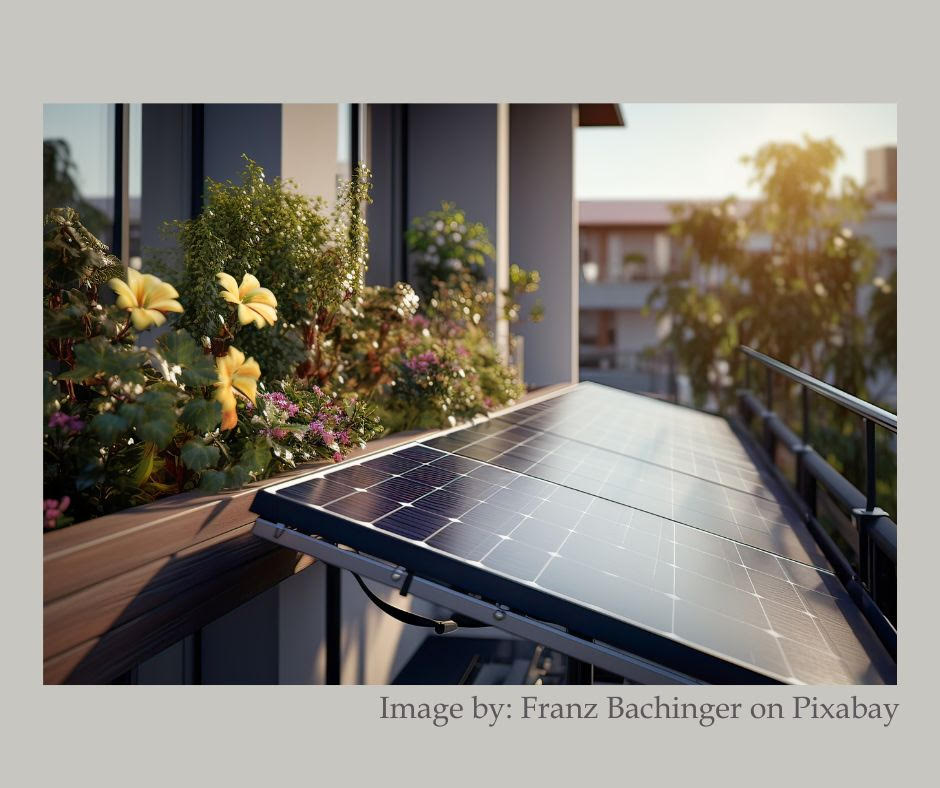
During the talk, McKibben mentioned balcony solar, something I had never heard about. It turns out I’m among the many in the U.S. who have never heard of balcony solar, otherwise known as plug-in solar. It has taken off in Europe, but not here, for a variety of reasons.
Yet, balcony solar may be an energy source most in keeping with our American ideals of self-reliance, as it allows people to be in charge of their own power and not dependent on industry or the government.
Balcony solar refers to small solar power systems (producing between 200 and 800 kilowatts of power) that can go on your balcony, on your fence, or out in your yard and plug directly into your household electrical outlets to provide power. When the system is plugged into your house electrical system, the solar power generated will provide power directly to your appliances, which will take their power from the solar panels first, and then the grid, when no more power is available from the panels. The power produced does not get put on the electrical grid. it can be used directly and/or stored on batteries to be used at another time.
Balcony solar has really taken off in Germany, where, according to the official count, over a million homes/apartments have installed it, though the actual count is thought to be much higher.
Though each balcony installation only produces a small amount of power, when millions of people are using them, the impact adds up. It is estimated balcony solar systems installed in Germany as of 2025 produce approximately 956 megawatts of power.
Unlike Germany, America has not installed much balcony solar. In addition to the fact that balcony solar is not something that many Americans know about, it has not taken off here yet due to some regulatory and technical issues as well as some false perceptions that need to be resolved.
Obstacles:
- Though the individual components of balcony solar systems are available in UL (Underwriters Laboratory – a trusted global safety organization that sets standards for product safety, performance, and sustainability) certified versions, UL has not established a safety standard for the balcony solar systems as a unit. This makes some individuals and communities hesitant to install/allow the installation of balcony solar.
- Some local utilities have rules that prevent people from installing their own systems, which makes the cost of balcony solar rise since people must hire a licensed electrician to install them.
- Some local utilities require people who install balcony solar to sign an interconnection agreement with them that adds cost to the project
- Since it is new to the US, and since different states, localities, and utilities have different rules, understanding what is necessary to install balcony solar can be confusing
Advantages:
- Balcony solar is portable so it can be placed in a sunny location on your property so you can have solar even if your roof is shaded by trees
- It is easy to install
- People living in apartments, who generally have no control over their power source, can use solar panels
- The balcony solar can move with you from one apartment or home to another
- Though balcony solar power systems are not large enough to run your whole house, they can serve as very useful back-up power for a few items in the aftermath of a natural disaster when the grid is down
- Balcony solar is much less expensive than a rooftop installation
- Balcony solar is pretty much “plug and play.” Depending on the state/municipality/utility rules, users can install it themselves and don’t have to jump through all the permitting and contractual hoops or pay electricians in order to get it up and running like homeowners who install rooftop solar do
Currently there is a movement of balcony solar installers, non-profits, and policy-makers who are trying to make it easier through policy and regulation for people to install balcony solar in the U.S.
Utah recently became the first state to pass a law, introduced by Republican Raymond Ward, making it easier to install balcony solar by exempting certain small solar power systems from utility interconnection agreements and having to wait for UL certification or other safety requirements to be determined.
Want to explore getting balcony solar yourself?
Check out Craftstrom, a Texas company that makes solar kits that can be used in the U.S. to find out detailed info on how their system works.
https://craftstrom.com/how-it-
Interested in helping ensure we pass regulations that make the adoption of balcony solar easier?
Check out Bright Saver, a non-profit that advocates for the adoption of balcony solar and for more user friendly regulations in addition to educating about and selling Flex Systems.
https://www.brightsaver.org/
Because balcony solar is new to the U.S., be sure to check with your local utility and municipality to ensure you understand all notification and permitting requirements before purchasing and installing balcony solar.
References and Resources:
https://www.nytimes.com/2025/
https://www.wired.com/story/
McKibben, Bill. Here Comes the Sun: A Last Chance for Climate and a Fresh Chance for Civilization. NY: W.W. Norton, 2025. Print.